



28.07.2026: Dorota Dutsch, Women in the Archive: An Argument with Silence
Why have we never heard of a female Plato or a female Confucius? The absence of women from traditional histories of philosophy reflects not only ancient inequalities in education and authorship but also the ways modern scholars have read the surviving archive. This keynote proposes a different approach to recovering women’s intellectual labor in antiquity. Beginning with Penelope’s weaving in Homer’s Odyssey, famously interpreted by Hannah Arendt as a metaphor for thinking carried out under conditions of exclusion, the lecture explores how women’s thought could emerge in forms not always recognized as philosophy. A contrasting example appears in the work of the Han-dynasty scholar Ban Zhao, who compared intellectual reflection to needlework—an activity that patiently connects disparate elements into a durable fabric of knowledge. Drawing on Michel Foucault’s concept of the archive as a living field of discourse, the talk argues that inscriptions, biographies, dialogues, and pseudonymous works preserve recoverable traces of women’s participation in ancient philosophical traditions.
About the Speaker: Dorota Dutsch, Professor of Classics, has an MA from the Jagiellonian University in Krakow (Poland) and a PhD (2000) from McGill University (Canada). She has taught at the Jagiellonian University, Université de Montréal, and worked as exchange scholar at the Conseil National de la Recherche Scientifique (France). Professor Dutsch’s research focuses on the interface of gender and knowledge in literary texts ranging form Greek philosophical prose to Roman comedy.

29.07.2026: Kateryna Karpenko, Ecofeminism in the context of the challenges of artificial intelligence
Studying artificial intelligence (AI) through an ecofeminist methodology opens up new perspectives on it as an ambivalent phenomenon. On the one hand, it is a tool for human survival in nature, and on the other, it poses threats to the existence of both humans and nature. The presence of this contradiction calls into question the narrative that technology is an abstract, neutral, or purely useful force. Data ecofeminism, a separate subfield of this intersection, illuminates the material realities of AI. AI as a “colonization of data” exacerbates ecological degradation and deepens social, gender, and racial inequalities.
About the Speaker: Prof. Dr. Kateryna Karpenko is Head of Department of Philosophy and Director of the Center for Gender Studies at Kharkiv National Medical University, Ukraine. Kateryna Karpenko defended her dissertation “The Gender dimension of the ecological communication” in 2006 at Kharkiv V.N. Karazin National University. She is a Doctor of Philosophy Science (2007), Professor (2008). She is a Head of the Department of Philosophy (2018), Director of the Centre for Gender Education (2012). She has published more than 200 works: monograph “Nature and Woman: Ecofeminist Perspectives in Ukraine” (2006, in Ukrainian). She took part in more than 100 International conferences in Ukraine, Germany, Great Britain, USA, China, Estonia, Hungary, Austria, Holland, Switzerland, Italy, Macedonia. The latest were the XV International Association of Women Philosophers (IAPh) Symposium ‘Philosophy, Knowledge and Feminist Practices’ (2014, Alcala, Spain), 24-th World Philosophy Congress (2018, Beijing, China), XVII International Association of Women Philosophers (IAPh) Symposium ‘Women and Philosophy in the era of globalization’ (2018), 10th Biennial conference of the European Society for Environmental History (ESEH) ‘Boundaries in/of Environmental’, Tallinn, Estonia (2019), XVIII International Association of Women Philosophers (IAPh) Symposium ‘Defining the Future, Rethinking the Past’ (Paderborn, Germany, 2021).
She initiated and coordinated the International Interdisciplinary Conference “Gender. Ecology. Health” (2007, 2008, 2011, 2015, 2017, 2019, 2021).
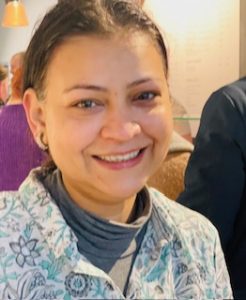
30.07.2026: Priyanka Jha, Dissent as Survival and Resistance in Global Populist Cultures: Herstory of Women’s Voices and Grammars in Indian Academia
One witnesses the rise of right-wing populist governments globally, reinforcing the patriarchal and masculine order, assaulting rights, dignity and selfhood of the most marginalised. The justification of oppression, in a series of violations of human rights, finds its source in the populist claim of ‘Making Nations Great Again’, the constant reinforcement of a problematic return to the past, and the oppressive traditions are reinforced. Across the sites of one’s being, the home and the outside, the presence of the state can be felt, through its umpteen policies in the garb of protecting the national interest or shaping the normative of the society. The politics of hatred, othering, sectarianism, communalism, and gender-based violence are the anchors on which the edifice of populist government stands tall. The democratic, inclusive way of politics is replaced by the politics of deception, in which the media plays a crucial role.
The central argument of this lecture is that feminist dissent and resistance challenge the gendered nature of populist governmentality. These global feminist movements—from the USA to India and beyond—raise issues such as bodily autonomy, equality, safe workplaces, sexual rights, and the rights of refugees and immigrants. Despite various approaches, the core of these movements resists a return to oppressive traditions rooted in the cultural matrices that have historically denied women selfhood. Feminist scholars, including Mrinalini Sinha, Nevidita Menon, Seyla Benhabib, Gloria Anzaldúa, and Uma Chakravarti, help unpack how cultural narratives reinforce subjugation, with women positioned as both bearers and victims of tradition.
This lecture contends that, rather than emphasising only the gendered challenges of populism, the focus lies on defiance, resistance, resilience, and hope. Despite mechanisms of control and violence, women around the world refuse silence, becoming vocal and agential in confronting populist regimes. Their dissent—including resistance, protest, and assorted movements—forms the heart of the response to the populist assault.
This keynote is interested in bringing her stories of resistance and dissent against the right-wing populist Government in India, the NDA coalition that has been in power since 2014. This regime is in the name of national interest and a return to the good old days of being ‘Vishwaguru’ (Source of Global Knowledge/Wisdom from Ancient times). The conservativism that foregrounds many of its policies, especially with regard to women and the LGBTQ community, has been called out, protested and dissented. From big movements and protests to everyday resistances, led by women and other gendered communities, have become crucial in the global herstory of resistance.
Focusing on Indian academia, this lecture illustrates the main argument by examining three pivotal movements in universities. These movements—led by students, faculty, and non-faculty—resisted intensified surveillance and conservatism, demanding equity for women and other gendered individuals. The three movements are:
- The first movement concerns resistance to changes in the academic syllabus and pedagogy beginning in 2015. Opponents challenged actions such as the closure of the Women and Exclusion Studies programme and significant alterations to history courses, which were perceived as attempts to limit diverse perspectives and promote a restricted view of the past.
- The second movement, the Me Too movement in 2018, arose in response to sexual harassment, focusing on the demand for safer academic environments. It expanded to include concerns about the precarious positions of untenured women faculty, recognition of invisible labour, and resistance to the silencing of women faculty and students in academic spaces.
- The third movement, Pinjra Tod (Break the Cage), began in 2015 as a campaign across Indian universities against discriminatory hostel regulations for female students. It advocated for equal rights and freedom within university spaces, with notable actions at institutions such as Banaras Hindu University in 2018.
Examining events at JNU, Jamia Millia Islamia, and Banaras Hindu University, these academic movements reveal diverse grammars of dissent and resistance. They demonstrate how challenges to the populist state take form within educational institutions, reinforcing the central claim that women’s collective resistance counters patriarchal and populist oppression.
About the Speaker: Priyanka Jha is Assistant Professor at the Banaras Hindu University, India and Visiting Felllow at the University of Oxford. Her area of work and research lies in the intersectionality of Political theory, thought and Intellectual history of ideas. She works and engages with writings and corpus of work that women thinkers contributed towards in Modern India and South Asia. In the larger context of gendering the manner in which values and concepts in the normative of nation came to be established. The aim is to identify, explore and engage with large number of women thinkers, who have been invisiblilised and marginalised from the larger national imagination and psyche. With this as the larger ambit, the attempts are towards decolonizing and gendering the pedagogy and syllabus which is constructed and narrativised with male gaze, celebrating solely the male thinkers and their contributions, as if women were absent from making history and contributing towards the human condition.
 31.07.2026: Ronny Miron, Between Encroachment and Appearance: The Phenomenology of Distance and Distance-lessness in Hedwig Conrad-Martius
One of the most inspiring aspects of the early phenomenological movement was its expanded notion of intuition, which broke away from traditional models centered on sense-data. In my presentation, I would like to direct attention to one of the most exciting figures in the early phenomenological movement, Hedwig Conrad-Martius, who was a central figure in the Göttingen Circle. In her 1916 treatise (based on her dissertation from 1913) titled Zur Ontologie und Erscheinungslehre der realen Aussenwelt, she reveals a highly complex and profound topography of intuition. While traditional empiricism and positivism flattened sensory experience into a homogeneous field of “sense-data” existing on a single plane of immediacy, Conrad-Martius argues for a fundamental phenomenological bifurcation between two distinct modes of givenness: “Sensation” (Empfindung) and “Appearance” (Erscheinung). I will argue that the key to understanding this split lies in the phenomenological axis of distance (Distanz) and distance-lessness (Distanzlosigkeit).
The first part of the lecture analyzes Conrad-Martius’s critique of representational theories through her distinction between perception and imagination. She describes imagination as “covered intuition” (verdeckte Anschaulichkeit), a state where the object is given through a “representative” or requires an active effort to bring the distant object into “intuitable proximity” (erschaubare Nähe). In contrast, perception is characterized by an “unveiled self-emergence” (unverhüllte Selbsthervortreten) where the object is given directly, breaking through the covering distance. Next, I will focus on the active ontological rift within sensory intuition itself, directly addressing the dynamic between immediacy and mediacy. Conrad-Martius deconstructs the notion of uniform sensory intuition by positing “Sensation” (such as touch, pressure, or bodily states) not as a representation of an object, but as an event defined by an absolute lack of distance. Sensation is described as an “encounter” or “encroachment” (Bedrängung) at the periphery of the bodily self; here, reality “touches” us with existential immediacy and “real contact” (Realkontakt), lacking the gap required for pictorial representation. In this state, the body, which is ontologically characterized as “closed,” absorbs the collision on a single real plane. Conversely, “Appearance” (embodied in vision and hearing) is characterized precisely by the maintenance of distance. Color and tone possess a “speaking nature” (sprechende Natur) that presents itself (Selbstpräsentation) “from afar” (von fern her), allowing the “living spirit,” which is inherently “open” by its very nature, to receive the object while preserving the aesthetic and ontological gap between them.
Against this background, Conrad-Martius’s realism will be presented as anchored in a fundamental dialectical tension: we are certain of the external world’s existence not only because we see it standing against us in the mediated distance of Appearance (which reveals its qualities to us), but because we collide with it through our bodies in the forced and immediate proximity of Sensation (which anchors us in its real hic et nunc). Consequently, there exists a wide variety of intuitions that are not merely passive receptions of data, but a multi-layered encounter with the autonomy of reality.
About the Speaker: Ronny Miron is a full Professor (since 2016) of Philosophy at Bar Ilan University, Israel. Her research is focused on post-Kantian Idealism, Existentialism, early Phenomenology, modern Hermeneutics, as well as current Jewish thought. She employs an interdisciplinary perspective combining the aforementioned traditions. She is the author of: Karl Jaspers: From Selfhood to Being (2012); The Desire for Metaphysics: Selected Papers on Karl Jaspers (2014); The Angel of Jewish History: The Image of the Jewish Past in the Twentieth Century (2014); Husserl and Other Phenomenologists (2018, edited book); Hedwig Conrad-Martius and Edith Stein – Philosophical Encounters and Divides, (2022, edited Volume with Antonio Calcagno); Hedwig Conrad-Martius, The Phenomenological Gateway to Reality, Springer (2021) and a second, revised and enlarged edition (2023).
You cannot copy content of this page