



 Abstract:
One of the most inspiring aspects of the early phenomenological movement was its expanded notion of intuition, which broke away from traditional models centered on sense-data. In my presentation, I would like to direct attention to one of the most exciting figures in the early phenomenological movement, Hedwig Conrad-Martius, who was a central figure in the Göttingen Circle. In her 1916 treatise (based on her dissertation from 1913) titled Zur Ontologie und Erscheinungslehre der realen Aussenwelt, she reveals a highly complex and profound topography of intuition. While traditional empiricism and positivism flattened sensory experience into a homogeneous field of “sense-data” existing on a single plane of immediacy, Conrad-Martius argues for a fundamental phenomenological bifurcation between two distinct modes of givenness: “Sensation” (Empfindung) and “Appearance” (Erscheinung). I will argue that the key to understanding this split lies in the phenomenological axis of distance (Distanz) and distance-lessness (Distanzlosigkeit).
The first part of the lecture analyzes Conrad-Martius’s critique of representational theories through her distinction between perception and imagination. She describes imagination as “covered intuition” (verdeckte Anschaulichkeit), a state where the object is given through a “representative” or requires an active effort to bring the distant object into “intuitable proximity” (erschaubare Nähe). In contrast, perception is characterized by an “unveiled self-emergence” (unverhüllte Selbsthervortreten) where the object is given directly, breaking through the covering distance. Next, I will focus on the active ontological rift within sensory intuition itself, directly addressing the dynamic between immediacy and mediacy. Conrad-Martius deconstructs the notion of uniform sensory intuition by positing “Sensation” (such as touch, pressure, or bodily states) not as a representation of an object, but as an event defined by an absolute lack of distance. Sensation is described as an “encounter” or “encroachment” (Bedrängung) at the periphery of the bodily self; here, reality “touches” us with existential immediacy and “real contact” (Realkontakt), lacking the gap required for pictorial representation. In this state, the body, which is ontologically characterized as “closed,” absorbs the collision on a single real plane. Conversely, “Appearance” (embodied in vision and hearing) is characterized precisely by the maintenance of distance. Color and tone possess a “speaking nature” (sprechende Natur) that presents itself (Selbstpräsentation) “from afar” (von fern her), allowing the “living spirit,” which is inherently “open” by its very nature, to receive the object while preserving the aesthetic and ontological gap between them.
Against this background, Conrad-Martius’s realism will be presented as anchored in a fundamental dialectical tension: we are certain of the external world’s existence not only because we see it standing against us in the mediated distance of Appearance (which reveals its qualities to us), but because we collide with it through our bodies in the forced and immediate proximity of Sensation (which anchors us in its real hic et nunc). Consequently, there exists a wide variety of intuitions that are not merely passive receptions of data, but a multi-layered encounter with the autonomy of reality.
 About the Speaker:
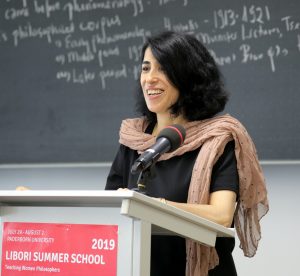
Ronny Miron is a full Professor (since 2016) of Philosophy at Bar Ilan University, Israel. Her research is focused on post-Kantian Idealism, Existentialism, early Phenomenology, modern Hermeneutics, as well as current Jewish thought. She employs an interdisciplinary perspective combining the aforementioned traditions. She is the author of: Karl Jaspers: From Selfhood to Being (2012); The Desire for Metaphysics: Selected Papers on Karl Jaspers (2014); The Angel of Jewish History: The Image of the Jewish Past in the Twentieth Century (2014); Husserl and Other Phenomenologists (2018, edited book); Hedwig Conrad-Martius and Edith Stein – Philosophical Encounters and Divides, (2022, edited Volume with Antonio Calcagno); Hedwig Conrad-Martius, The Phenomenological Gateway to Reality, Springer (2021) and a second, revised and enlarged edition (2023).
______
Interested in seeing the Lecture live? Then sign up here for the Libori Summer School 2026: https://indico.uni-paderborn.de/event/157/
If you want to participate actively in this or other sessions, please consider our call for applications: https://historyofwomenphilosophers.org/call-for-applications-libori-summer-school-2026/
You cannot copy content of this page