


 The New Voices on Women in the History of Philosophy network, which is open to early-career researchers in the broadest sense, is hosted by the Center for the History of Women Philosophers and Scientists in Paderborn. The objective of New Voices is to establish a forum and network for international early-career researchers in the field of female philosophers, scientists, and writers in the history of philosophy, and to promote their work.
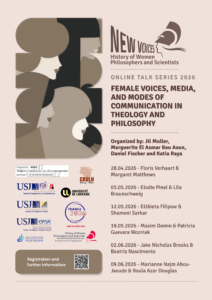
In the Spring of 2026, the New Voices Talk Series will once again embrace a spirit of collaboration. This joint project represents a partnership between three universities: the University of Paderborn, the Saint Joseph University of Beirut, and the University of Lorraine. The organizers are: Dr. Jil Muller; Dr. Marguerite El Asmar Bou Aoun; Dr. Daniel Fischer and Dr. Katia Raya.
Everyone is welcome to attend. Please register here and you will get the Zoom-Link after registration.
The Whole Program:
28.04.2026, 4.30-6pm (Paris time): 2 lectures
Floris Verhaart – Johanna Dorothea Lindenaer: Memoirist, Translator, and Religious Polemicist
After being accused of treason and conspiracy, a young widow was imprisoned by the Dutch army in Maastricht. With the help of an army officer and two of his soldiers, she managed to escape and fled to Paris in 1704, where she converted to Catholicism and became a writer and translator. The name of this widow was Johanna Dorothea Lindenaer (nom de plume: Mme Zoutelande). Among her original publications are a notoriously unreliable memoir (1710) and a renunciation of her former Protestant beliefs, La Babylone démasquée (1727). Her translations – translated from Dutch into French – include a selection of letters written by Anna Maria van Schurman (1607-78) on the relationship between medicine and divine providence (Lettres de la très fameuse demoiselle Anne-Marie Schurmans, 1730) and a treatise on political theory with a distinctly republican flavour by Pieter de la Court (1618-85), the Memoires de Jean de Wit, grand pensionnaire de Hollande (1709). Although this written output may seem like a mishmash of topics, I will demonstrate how Lindenaer’s writings and translations across a range of genres and themes convey a coherent religious agenda aimed at defending Catholicism from Protestant polemicists and at commenting on contemporary tensions between Jansenists and their opponents within the Catholic church. Both in her translations and in her original writings, Lindenaer makes clever use of the arguments and formulations of others to get her own points of view across to the reader. This helps her retain the intellectual modesty expected of women in the early modern period. After all, she could claim she merely reported and conveyed other people’s ideas. I will therefore argue that Lindenaer was not just a religious author and translator who happened to be a woman; her gender is key to understanding her writings from a religious perspective.
About the Speaker: Floris Verhaart is a postdoctoral research fellow at the University of Exeter. He is affiliated with the ERC/UKRI project Cultures of Philosophy: Women Writing Knowledge in Early Modern Europe and has published on a wide range of aspects of early modern religious and intellectual culture, such as ideas on religion and violence, sexuality and gender, university culture, and the impact of the classical tradition. He is the author and (co)editor of five books, including Protestant Politics Beyond Calvin: Reformed Theologians on War in the Sixteenth and Seventeenth Centuries (Routledge, 2022, co-edited with Ian Campbell) and Classical Learning in Britain, France, and the Dutch Republic, 1690-1750: Beyond the Ancients and the Moderns (OUP, 2020).
Margaret Matthews – Rhetoric, Method, and Genre in Gabrielle Suchon’s Treatise on Ethics and Politics
In this talk, I discuss the genre, methodology, and mode of communication used by early modern philosopher Gabrielle Suchon in her Treatise on Ethics and Politics (1693), and describe its relation to her feminism. I examine how Suchon adapts aspects of the theological genre and methods of Scholasticism, redirecting them toward new ends, namely, an extended argument for the moral, intellectual, and spiritual equality of men and women. I show further how Suchon’s appropriation of Scholasticism renders her feminist project distinctive within her seventeenth-century context, contrasting it with that of feminist writers in the querelle des femmes tradition (e.g., Marie de Gournay and Marguerite Buffet) and Cartesian feminists (e.g., François Poulain de la Barre and Mary Astell). When considering the rhetorical features of Suchon’s work, scholars have often emphasized her efforts to communicate with a female audience and to cultivate generosity and solidarity in her female readers. Much less scholarly attention has been given to Suchon’s mode of communication with male audiences and her use of traditionally male-dominated genres, such as Scholasticism, to advance her feminist project. I show how Suchon draws on Scholastic methods and genres, such as dialectic and the disputed question format, as well as concepts within Thomistic natural law theory, to reach a specific type of male reader, namely one steeped in the Scholastic tradition. On one level, her goal is to persuade this type of reader that concern with the elevation of women’s status is not only consistent with, but also demanded by the Thomistic theoretical framework that he accepts. On another level, by appropriating a traditionally male-dominated genre, Suchon’s goal is to reclaim a position of epistemic authority that has been denied to her as a woman writer, and to perform (through her own example) the very equality she seeks to prove.
About the Speaker: Margaret Matthews is an Assistant Professor of Philosophy at Assumption University. Her research specialization is in Renaissance and Early Modern philosophy with an emphasis on the intersection of epistemology and social and political philosophy. She has published on topics such as Gabrielle Suchon’s epistemology and Marie de Gournay’s skepticism, and she is currently working on a book project on the philosophy of Gabrielle Suchon.
05.05.2026, 4.30-6pm (Paris time): 2 lectures
Elodie Pinel – Vernacular Theology and Authority: Marguerite Porete, Mechthild of Magdeburg, Hadewijch of Antwerp
This paper examines the writing of Marguerite Porete, Mechthild of Magdeburg, and Hadewijch of Antwerp as a distinct mode of speculative discourse that can be understood, following McDonnell, as vernacular theology. Rather than denoting a merely linguistic choice, “vernacular” here refers to a relocation of theological authority outside clerical, scholastic, and institutional frameworks, into forms of expression rooted in lived experience and the rhetorical resources of lyric and narrative. Each of these writers develops a conceptual reflection on the soul’s union with God that is neither derivative of scholastic thought nor reducible to affective piety. Porete articulates a radical theology of dispossession of the will: the soul in Love becomes “without why,” beyond virtue and rational effort. Hadewijch theorizes Minne as a demanding reciprocity between the soul and God, where love is both ontological ground and ethical trial. Mechthild describes the divine as a dynamic “flowing light” that both consumes and renews the soul, elaborated through intensely embodied imagery. In each case, theological insight is embedded in poetic, dialogical, and visionary forms, which are not ornamental but constitutive of meaning. These women write in vernacular languages—Old French, Middle High German, Middle Dutch—but more importantly, they write in vernacular forms: song, dialogue, allegory, visionary narrative. Such media allowed them to communicate theology as transformation, not proposition. Their texts construct communities of reception independent of academic institutions: readers, listeners, fellow laywomen, informal circles of devotion. Communication is therefore not simply transmission but negotiation of authority. By claiming the right to speak of God from lived experience, they challenge clerical monopoly over theological discourse.This paper argues that the theological originality of these mystics lies precisely in this convergence of speculative rigor and vernacular expression. Their work demonstrates that the history of philosophy cannot be restricted to scholastic production, and that forms of communication themselves shape what counts as legitimate knowledge.
About the Speaker: Élodie Pinel is a lecturer in philosophy and a specialist in medieval French literature. Agrégée in both modern literature and philosophy, she focuses on Marguerite Porete and the intellectual legacy of female mystics. She explores the intersections of theology, literature, and philosophy, with a special interest in will, language, and freedom. She completed her PhD on Le Miroir des âmes simples at Université Paris Nanterre, where she is affiliated with the research center CSLF (Centre des Sciences des Littératures en Langue Française). She is also active in public philosophy through podcasts and feminist publishing
Lila Braunschweig – A Voice of One’s Own: Philosophizing as Feminized Subjects (Impostor Syndrome & Authority)
This presentation offers an investigation into the complicated, doubtful, and sometimes painful relationship feminized subjects have with philosophical activity. Drawing on the analyses of French philosopher Michèle Le Doeuff regarding the place of women in philosophy, as well as accounts from women philosophers, I aim to identify some of the reasons behind what has been termed “feminine doubt” (Casselot 2018), commonly known today as impostor syndrome. I will argue that these doubts regarding one’s philosophical authority cannot solely be explained by the now well-known reasons, such as the lack of female figures in the traditional canon of continental philosophy, or the hostility of certain philosophical texts or contexts towards women, whether they are philosophers or not.By linking Le Doeuff’s arguments with those of other Francophone and Anglophone Western feminist thinkers and writers, I will demonstrate that these doubts may also stem from the unique relationship to knowledge and authority shaped by feminine socialization and its intersection with class and race. This, in turn, hinders feminized subjects from expressing and asserting their own unique voice. I will argue that philosophy, and more broadly the ability to generate new ideas in the academic field, requires an attitude of self-assertion, as well as a capacity for disruption that is sometimes at odds with the attitudes of submission promoted by certain feminine norms and societal expectations for women in Western societies. Therefore, the ability to assert oneself as a philosophizing subject not only requires “a room of one’s own” (Woolf, 1929), but also the development of a voice of one’s own. Finally, on a more personal note, I will reflect on the remedies and practices that, in a non-ideal world, have helped me find my own voice as a theorist, assert my viewpoint, and assume a certain philosophical authority. In particular, I will discuss the rich and transformative experience of creating and participating in a women-only writing group with young Francophone feminist scholars.
About the Speaker: Lila Braunschweig is an assistant professor of French literature and culture and a research affiliate at the Institute for Cultural Inquiry (ICON) at Utrecht University. She holds a PhD in political science from Sciences Po (France). Before joining Utrecht, she was a British Academy Newton international postdoctoral fellow at the University of Kent, and a postdoctoral fellow in philosophy at the Centre de recherche en éthique (CRÉ) in Montreal, and the Chaire de recherche du Canada en éthique féministe at the Université du Québec à Trois-Rivière. Previously, she has also been a visiting researcher and international Fox fellow at Yale University (2019-2020). Her first book (Neutriser: emancipation par le neutre) was published in French by Les Liens qui Libèrent in 2021. Her second monograph (Vers la délicatesse. Une philosophie relationnelle de la liberté) will be published by Gallimard in 2026. Her work has also appeared in La Revue française de science politique, Philosophiques, Political Theory, Recherches féministes, the International Journal for Gender, Sexuality and Law, and Genre, Sexualités, Société.
12.05.2026, 4.30-6pm (Paris time): 2 lectures
Elżbieta Filipow – Women’s Writing of Harriet Taylor Mill and its Various Modes of Self-expression
Harriet Taylor Mill (1807–1857) was a long-time friend, intellectual partner, and, eventually, wife of John Stuart Mill (1806–1873) – one of the main representatives of utilitarianism and an advocate of feminism. My preliminary research has shown that Harriet Taylor Mill is an almost entirely absent figure in the field of literary studies. The aim of my presentation will be to highlight her contribution to the development of women’s writing, aesthetics, and literary self-reflection, based on her essays in aesthetics, literary criticism, and poetry. Although the topic of Harriet Taylor Mill’s female writing is completely overlooked from the perspective of her contributions to social thought or feminist philosophy, it is, in my view, worth taking a closer look at these insufficiently explored aspects of various modes of self-expression in her literary activity. Doing so may show her creative output in a different light: as that of a writer with a critical sensibility towards literary work and as a poet addressing themes linked to emotions arising from motherhood and marriage. Particularly, this last element of her female voice inwriting may serve to complete her portrayal as a woman who attempted to reconcile her feminist beliefs with family life – a considerable challenge in the Victorian era. Ultimately, I will argue that it is possible to demonstrate that Harriet Taylor Mill’s works represents an example of female writing as a form of self-reflection, which ambivalently set for and against her own perception of the social issues related to gender inequality within the broader context of the role and place of women in Victorian society.
About the Speaker: Elżbieta Filipow holds MA in sociology and BA in philosophy. Since 2022 she is working as a research assistant in the Department of Ethics at the Faculty of Philosophy at the University of Warsaw and she is principal investigator in the research project entitled ‘The Place of Equality in John Stuart Mill’s Utilitarianism’ financed by the National Science Centre (Poland) and a research assistant in the project ‘Enlightenment-Era Pedagogical Reforms and Arguments against the Gendered Conception of Human Progress in Poland and Germany’ financed by National Agency of Academic Exchange (NAWA, Poland). She is completing her doctoral dissertation in philosophy entitled ‘Perfectionism and Justice. The Equality of Women and Men in John Stuart Mill’s Utilitarianism’. Since 2024 she is doctoral student in a Doctoral School in Sociological Science at the University of Bialystok (Poland). Her doctoral dissertation focuseson the contribution of Harriet Taylor Mill into the canon of sociological thought. In 2024 she was an Academic Visitor at the Faculty of Philosophy, Oxford University and conducted research in The John Stuart Mill Library at Somerville College.
Shamoni Sarkar – Karoline von Günderrode: Fragmentation, Philosophy, and Early German Romanticism
In this paper, I argue for a creative ethics grounded in fragmentation in the work of the early German romantic poet and philosopher Karoline von Günderrode. Scholarship on Günderrode is scant, but commentators have emphasized, among other themes, her novel environmental ethics and Naturphilosophie, as well as her original philosophy of gender and selfhood. However, the larger hermeneutics of the early romantic fragment as a form of philosophical communication has not been sufficiently investigated in terms of her philosophical conception, especially given her role as a woman on the fringes of the movement. With this in mind, I provide a close reading of Günderrode’s essay-fragment “The Idea of the Earth” (Die Idee der Erde) and her lyric poem “The Kiss in the Dream” (Der Kuss im Traume) to show how her concept of the spiritual will, life, and dream-inspired creativity all depend on an underlying conception of fragmentation at the core of willing, living, and dreaming. We are confronted with fragmentation as both a threat as well as a sustenance of our collective life on earth and of our creative communication. Therefore, writing in the fragment form is a direct expression of the pain of philosophizing and poeticizing from within a context of a world and a creative will that is consistently torn apart seemingly by its own volition. Günderrode’s work appeals to our imaginations to see and to use this pain to re-imagine the real rather than chase the ideal. Ideal unity functions more as a limit condition of this philosophical activity rather than as a destination.
About the Speaker: Shamoni Sarkar obtained her PhD in Philosophy from the University of California, Riverside in Fall 2025. Her dissertation argued for a conception of openness in community in Early German Romantic philosophy. This is facilitated by the process of reading and understanding the early romantic fragment– in which finitude and infinitude work themselves out together. From 2023-2024, she was an associated doctoral fellow at the Freie Universität Berlin, funded by an Einstein Stiftung grant. In the future, she plans to focus more on women philosophers from the period, and on investigating alternative forms of ‘philosophizing’ as a form of community creation.
19.05.2026, 4.30-6pm (Paris time): 2 lectures
Maxim Demin – Philosophy, God-Seeking, and Developmental Psychology: Stolitsa and Volkovich in Late Imperial Russia
This presentation examines the philosophical project of two largely forgotten Russophone women thinkers, Zinaida Stolitsa (1873–1956) and Vera Volkovich (1873–1962). As co-authors and lifelong partners, they developed a distinctive body of work at the intersection of religious philosophy, developmental psychology, and pedagogical reform during the final decades of the Russian Empire. Their voices, once publicly visible, were later marginalized and silenced under Soviet rule.Stolitsa and Volkovich strategically used a wide range of media and communicative forms to articulate a female philosophical voice within the early twentieth-century God-Seeking movement. Their collaborative writings, most notably the manifesto The Future in Our Hands (1909), combined speculative religious philosophy with emerging scientific approaches to child psychology. They published philosophical essays, reviews, and programmatic statements of their independent society, and they also participated in international scholarly events in Geneva (1909) and The Hague (1912). These diverse communicative strategies enabled them to claim intellectual authority within discourses traditionally dominated by men. Their reworking of central theological and philosophical concepts, particularly Stolitsa’s reinterpretation of Man-Godhood, formulated partly in a one-sided polemic with figures such as Nikolai Berdiaev, provided a conceptual foundation for their broader agenda of moral, spiritual, and national renewal. Their work also contributed to the early twentieth-century feminisation of pedagogical expertise, placing women at the center of discussions on education and child development. The paper will highlight the paradoxical ideological constellation that shaped their project: an upper-class background combined with conservative moral views; openness to feminist concerns; aspirations for international intellectual exchange; and, simultaneously, elements of Russian imperial nationalism and cultural chauvinism on the eve of the First World War. The presentation will also draw on archival photographs and visual materials, offering a tangible sense of their intellectual and social world.
About the Speaker: Maxim Demin is a research fellow at the Ruhr University Bochum (Germany). His main interest is post-Hegelian philosophy and its intellectual development in German-speaking countries during the nineteenth century. Before moving to Bochum, he taught for nearly a decade at the National Research University – Higher School of Economics (HSE) in St. Petersburg and Moscow, offering courses in critical thinking, philosophy of science, metaethics, and moral psychology. His current project explores Russian philosophical and public debates on the emergence of studies of human and animal psychology and mental phenomena, tracing the transfer of psychological knowledge from the early nineteenth century to the early Soviet regime.
Patricia Guevara Wozniak – The Metaphysical Tenacity of Barbara Skarga – Metaphysics in Totalitarianism
Contrary to twentieth-century proclamations of the “death of metaphysics” and the erosion of truth, Barbara Skarga persistently defended the metaphysical dimension of human existence. For Skarga, metaphysicality constitutes the core of being; its eradication would entail a loss of humanity itself. Her philosophical stance gains particular significance when considered against the backdrop of totalitarian experience, including her imprisonment in the Gulag. Skarga’s reflection on metaphysics centers on the notion of the source of being, explored primarily through the categories of time, evil, and experience. In a series of philosophical essays, she emphasizes both the difficulty and the ethical-intellectual value of seeking the origins of being. She critically engages classical conceptions of time—physical, psychological, and cosmological—while foregrounding lived temporality as structured by finitude. Her analysis of evil exposes philosophy’s enduring struggle to comprehend it: as privation of good, corruption of human nature, or an inescapable dimension of social violence, paradoxically accompanied by utopian visions of moral redemption. Addressing experience as a source of being, she enters into dialogue with thinkers such as Plotinus, Husserl, and Heidegger. After returning from the Gulag in 1955 and completing her studies, Skarga joined the Institute of Philosophy and Sociology of the Polish Academy of Sciences, remaining associated with it throughout her career. Although her early academic choices were shaped by Adam Schaff’s centrally planned research agenda, they ultimately became foundational to her intellectual development and to the formation of the Warsaw School of the History of Ideas. Skarga’s work can be divided into five stages: studies of Polish and French positivism; research on non-positivist currents in nineteenth-century French philosophy, culminating in her engagement with Bergson; a metaphilosophical reflection on the methodology of the history of philosophy; a “post-critical” metaphysics informed by phenomenology and hermeneutics; and, finally, moral and civic essays affirming the durability of European values. Rather than offering rigid definitions, Skarga reveals the plurality of meanings and historical configurations through which metaphysical questions persist.
About the Speaker: Patricia Guevara Wozniak is a Doctor of Humanities in the field of philosophy, editor, academic lecturer, and educator. A graduate of the Academy of Film and Television. She has collaborated with the Academy of Art and Design and with Pedagogium – the University of Social Sciences in Warsaw. She is currently a lecturer at Kozminski University. She is a beneficiary of the Culture in the Network program awarded by the Minister of Culture and National Heritage and administered by the National Centre for Culture. She is the editor-in-chief of the nationwide monthly Remedium (remedium-psychologia.pl), funded by the Ministry of Health and administered by the National Centre for the Prevention of Addictions, a professional magazine providing up-to-date information on modern methodologies of education and prevention.
02.06.2026, 4.30-6pm (Paris time): 2 lectures
Jake Nicholas Brooks – Autonomy Beyond Kant: Butler, Tronto, and Interdependence
The aim of this contribution is to highlight – from a standpoint of intersectional critique – the limitation of the Kantian conception of autonomy, grounded on a male and autonomous subject, that has shaped Western philosophical and theological discourses. The contribution will develop along two complementary lines. First, drawing on Butler’s critique of the State of Nature tradition, it will show how the subject of modern philosophy has always been conceived as already adult, male, and autonomous, thus masking the condition of dependency inherent to human beings. Butler’s analysis reveals how this framework is produced through exclusions of those identities, which are shaped by gender oppression and racialization. Butler’s work demonstrates that dependency is not a deviation from the norm, rather a constitutive feature of human life. Secondly, relying on Tronto’s care ethic, the contribution will argue that humanity is better understood as grounded on interdependence, where care relationships are not only fundamental for democratic societies, but also for a responsible and adequate care of human beings. Tronto’s analysis highlights how the unequal distribution of care labor – which is historically borne by women or racialized and marginalized groups – is grounded on “passes” given to men, that exempt them from care responsibilities. Through Tronto’s theory it will become clear that a model of humanity grounded on interdependence and responsibility is necessary for a more equal ethical and political life. Through this two-fold analysis, this contribution aims at demonstrating the necessity for an ontological shift: it is necessary to overcome the conception of humanity as male-centered, autonomous and self-made, to a vision of humanity as interdependent, needy, vulnerable, and relational.
About the Speaker: Jake Nicholas Brooks is MA graduate with honors in Philosophy at University of Rome “La Sapienza”. His research interests revolve around Political Philosophy, Feminist Theories, and Gender Studies. He carried out a thesis on the Habermasian conception of progress. He has published an article in double-blind peer review for Quaderni Leif – ethical and moral journal from the University of of Catania – on Tronto’s ethics’s of care and Simone Weil’s perspective on war. He is currently working on a paper for Etica-Mente, another journal of University of Catania, concerning Tronto’s conception of interdependence.
Kaimé Guerrero Valencia – Intervening Assemblages of Trans-formation/Action: Beatriz Nascimento (1942-1995)
This paper examines the intellectual, artistic, and political contributions of Beatriz Nascimento (1942–1995), a leading figure of Brazil’s Black Movement. It situates her work at the intersection of historiography, aesthetics, and political theory, showing how she developed innovative conceptual and methodological tools to contest colonial structures of knowledge and create new practices of Black autonomy. Through an interdisciplinary analysis of her essays, poetry, archival materials, and the documentary Ôrí (1989), the paper argues that Nascimento, by mobilizing writing, film, and activism as intertwined strategies, elaborates a distinct theoretical, methodological, and ethical approach that redefines Black historiography, advances the conception of a Black utopia, and reconfigures the quilombo (maroon societies) as a political and existential category. At the core of Nascimento’s oeuvre is the concept of trans-formação/ação, a neologism that denotes processes of transformation enacted through language. She theorizes language not as a neutral medium but as a site of material and historical change, capable of unsettling hegemonic orders and generating new forms of collective subjectivity. The paper demonstrates how she strategically combined academic, poetic, and cinematic registers to transform language itself into an instrument of resistance. Nascimento’s work establishes the conditions for new forms of Black historiography in which freedom is articulated not as an abstract universal but as a lived and collective practice. Her oeuvre constitutes an embodied, aesthetic, and political historiography of the Black diaspora, in which the quilombo functions as both archive and horizon of freedom, and Black utopia materializes through collective practices of memory, writing, and resistance.
About the Speaker: Kaimé Guerrero Valencia were born in Quito, Ecuador, and has been living in Berlin for ten years. They studied sociology and political science at the Pontificia Universidad Católica del Ecuador, followed by a MA degree in interdisciplinary Latin American studies with a gender profile at the Free University of Berlin. They are currently completing their PhD in the Collaborative Research Center Intervening Arts in the Faculty of Humanities at the University of Duisburg-Essen. Their research interests include the intersections between aesthetic, political and scientific processes in the production of alternative forms of word-making.
09.06.2026, 4.30-6pm (Paris time): 2 lectures
Marianne Najm Abou-Jaoude – Beneficent Communication as Power
This presentation proposes a three-level framework—safe, responsible and beneficent—to analyse and foster constructive forms of women’s agency in contemporary digital media ecologies. “Safe” designates not engaging in practices and structures that include violence, exploitation and manipulation online and offline. “Responsible” refers to doing no harm, ensuring fairness and structural justice. “Beneficent” goes further, namely actively promote the flourishing of others, create conditions for dialogue and build the common good, and is presented as the key to reimagining women’s power in and through media. Drawing on case studies of women communicators in religious, civic and grassroots community contexts, this research examines digital practices through the three cumulative levels of positive ethics in communication to illuminate how such engagements challenge exclusionary structures in theology and philosophy. A few case studies examples would be first, women moderating encrypted messaging groups that coordinate neighborhood mutual aid and emotional support while establishing clear norms of safety and verification. A second examines women leaders in faith-based digital communities who use livestreams and social media to host spaces of shared discernment, interreligious encounter and reconciliation. A third considers women running community radio and podcast collectives that platform the voices of migrant, indigenous or otherwise marginalised women, combining journalistic rigour with participatory storytelling.
About the Speaker: Marianne Najm Abou Jaoude is a telecom engineer finishing her doctoral research at Sophia University Institute near Florence in Italy. Her thesis concerns ethics of AI and the responsibility of everyone in building a safe and peaceful future. She developed a framework about a digital oath that includes beneficence in communication and systems design, and the role of technology such as generative AI in peacebuilding and depolarization. Her work examines progressive ethical levels and the concept of collaborative positive ethics to foster human-centric innovation and inclusive digital communication.
Roula Azar Douglas – Women’s Digital Voices and the Reconfiguration of Public Debate
In the contemporary digital landscape, social media platforms, blogs, and online communities have emerged as significant spaces where women articulate political, philosophical, religious, or secular positions. Far from being peripheral, these digital arenas are vital sites for rethinking legitimacy, influence, and participation in public discourse. This paper examines how women — from secular thinkers and educators to feminist digital activists, as well as Christian pastors in Europe and Muslim scholars in the Arab world — use digital media to challenge traditional frameworks, reinterpret doctrines or social norms, and create alternative spaces for reflection, critique, and debate. Through selected case studies, the paper analyzes strategies these women employ to reach diverse audiences: the mobilization of storytelling and personal narrative, the use of pedagogical tools, and the deliberate cultivation of online communities that function as safe spaces for questioning and dissent. It also considers aesthetic and rhetorical choices — such as visual branding and accessible language — that enhance the effectiveness of their digital presence. Particular attention is devoted to how these actors navigate visibility in environments where religious, cultural, or political expectations can restrict women’s public expression. This includes facing harassment, censorship, or community backlash, while leveraging alliances, digital solidarity networks, and transnational audiences to amplify their voices. The study highlights how digital platforms enable women to bypass traditional gatekeepers and establish new forms of authority rooted in experience, authenticity, and community engagement. Ultimately, it sheds light on how online spaces are reshaping women’s participation in intellectual and spiritual debates, highlighting both persistent obstacles and emerging opportunities for more inclusive, plural, and transformative dialogue.
About the Speaker: Roula Azar Douglas is a Lebanese-Canadian researcher, journalist, writer, and academic who currently serves as Dean of the Faculty of Information and Communication at Antonine University. She is the founder and president of the Union de la presse francophone – Liban (UPF Liban), and a mentor with the Global Thinkers Forum in London. Douglas coordinates the National Observatory of Women in Research (CNRS-L), oversees a weekly page on universities, research, and youth for L’Orient-Le Jour, and is also the author of two novels: Le jour où le soleil ne s’est pas levé (2018) and Chez nous, c’était le silence (2007). She has a strong interest in the role of media in shaping social realities.
This New Voices Series is organised by the Center for the History of Women Philosophers and Scientists, at Paderborn University, and in Cooperation with







You cannot copy content of this page