



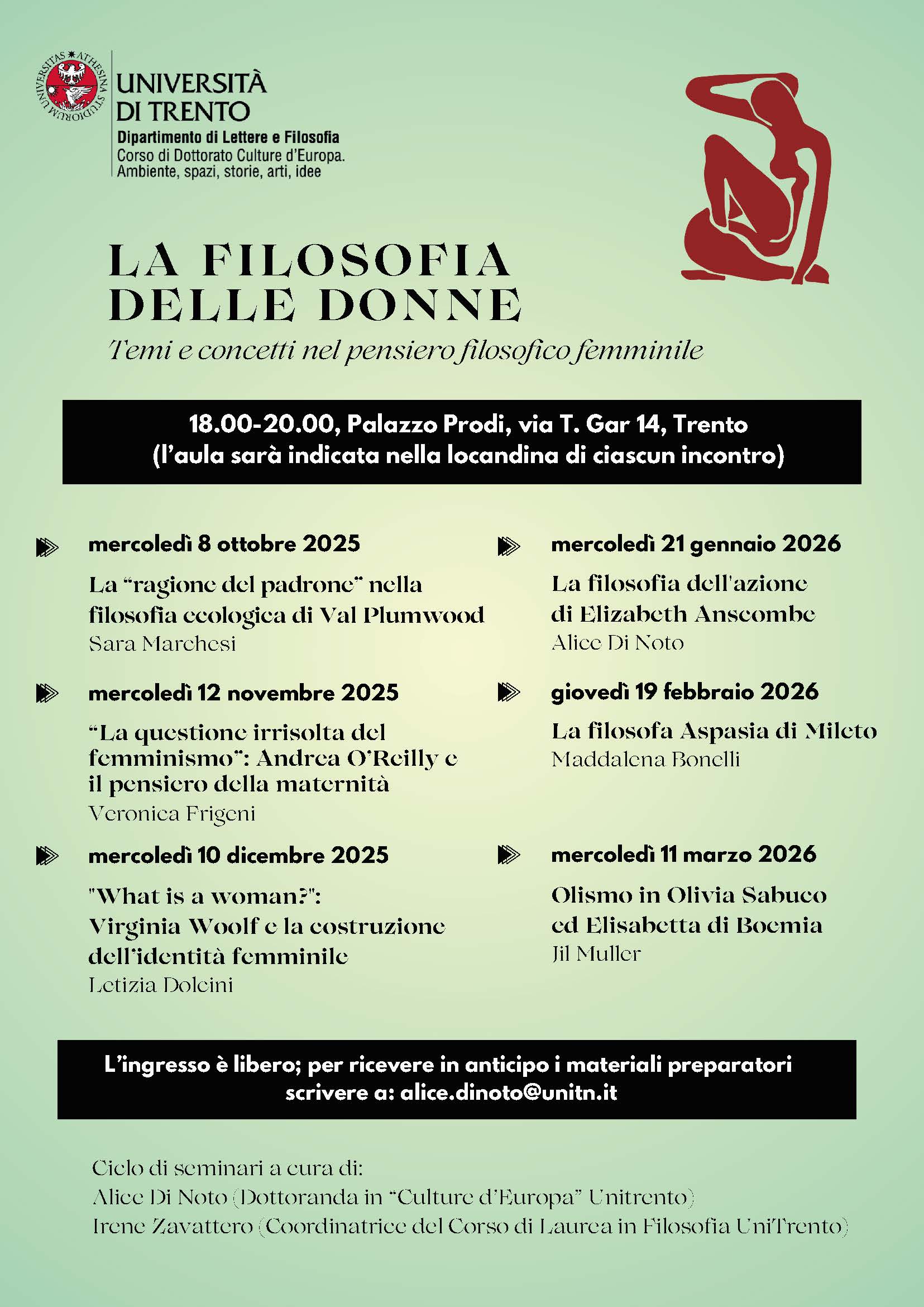
Talk by Jil Muller – Olismo in Oliva Sabuco ed Elisabetta di Boemia
Talk | 6:00 PM - 8:00 PM |
Dr. Jil Muller will give her talk in the seminar “La filosofia delle donne 2025-2026 Temi e concetti del pensiero filosofico femminile” at Università di Trento.
Abstract of the Talk
Oliva Sabuco ed Elisabetta di Boemia adottano entrambe un approccio medico allo studio dell’essere umano inteso come un tutto unificato, ma lo fanno partendo da presupposti filosofici nettamente diversi. Nella Nueva filosofía de la naturaleza del hombre (1587), Sabuco concepisce l’essere umano come un’unità integrata la cui salute e vita morale dipendono dall’armoniosa relazione tra corpo e anima. Tale unità, tuttavia, si fonda su una chiara separazione ontologica tra i due: l’anima e il corpo sono distinti per natura, ma la loro interazione, specialmente attraverso le passioni, ha effetti fisiologici e psicologici diretti. Per Sabuco, riconoscere questa distinzione è proprio ciò che permette di comprendere come gli stati mentali possano influenzare la salute del corpo e come le condizioni fisiche possano influire sull’anima, preservando così una visione olistica senza far collassare i due in un’unica sostanza. Elisabetta di Boemia, invece, mette in discussione la coerenza stessa di tale separazione. Nella sua corrispondenza con Cartesio, sfida notoriamente il dualismo cartesiano chiedendosi come una mente immateriale possa interagire causalmente con un corpo materiale. Per Elisabetta, l’essere umano non può essere adeguatamente compreso se la mente e il corpo sono concepiti come sostanze radicalmente distinte, poiché ciò rende la loro interazione oscura e filosoficamente insoddisfacente. Le sue riflessioni suggeriscono che una comprensione autentica dell’essere umano nel suo insieme richiede un ripensamento della natura dell’anima, del corpo e del concetto stesso di causalità.
Oliva Sabuco and Elisabeth of Bohemia both adopt a medical approach to the study of the human being as a unified whole, but they do so starting from distinctly different philosophical assumptions. In Nueva filosofía de la naturaleza del hombre (1587), Sabuco conceives of the human being as an integrated unit whose health and moral life depend on the harmonious relationship between body and soul. This unity, however, is based on a clear ontological separation between the two: the soul and the body are distinct by nature, but their interaction, especially through the passions, has direct physiological and psychological effects. For Sabuco, recognising this distinction is precisely what allows us to understand how mental states can influence the health of the body and how physical conditions can affect the soul, thus preserving a holistic view without collapsing the two into a single substance. Elisabeth of Bohemia, on the other hand, questions the very coherence of this separation. In her correspondence with Descartes, she famously challenges Cartesian dualism by asking how an immaterial mind can interact causally with a material body. For Elisabeth, human beings cannot be adequately understood if the mind and body are conceived as radically distinct substances, as this makes their interaction obscure and philosophically unsatisfactory.His reflections suggest that a genuine understanding of the human being as a whole requires a rethinking of the nature of the soul, the body, and the very concept of causality.
 share
share tweet
tweet