



Last year, Dr. Andreas Vrahimis gave a talk in the New Voices series Women in Analytic Philosophy and Philosophy of Science on L. Susan Stebbing’s critique of F. C. S. Schiller’s pragmatist theory of truth. Missed the talk? No worries.
You can watch this lecture – and all other talks from the New Voices series – on our YouTube channel:
Abstract:
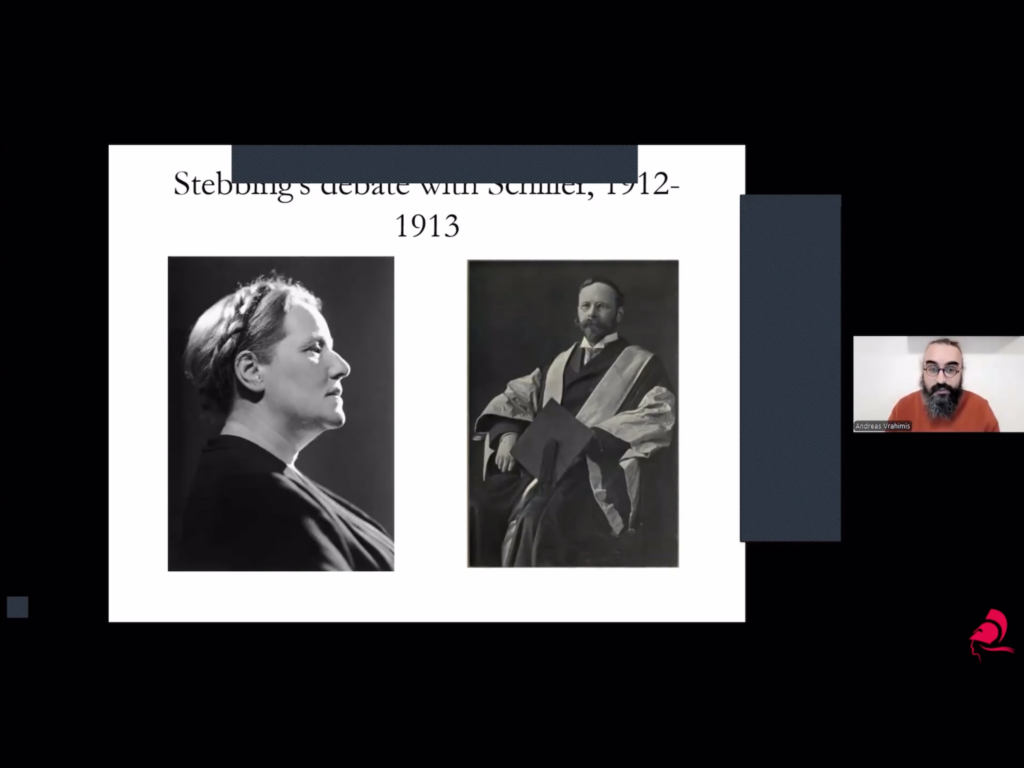
Whereas early criticisms of pragmatist theories of truth by analytic philosophers like Russell and G.E. Moore are well known, and helped shape the ongoing debates on this topic, L. Susan Stebbing’s significant contributions to the debate have hitherto largely been ignored. At the outset of her career, Stebbing became embroiled in a controversy with F.C.S. Schiller, spanning multiple publications, in which she objected against his variant of the pragmatist account of truth. As Chapman notes, the debate is somewhat abstruse and ‘does not make very satisfactory reading’ (2013, 30). It involves multiple forms of miscommunication, largely due to Schiller’s failure, throughout the debate, to acknowledge the significance of some of Stebbing’s arguments. In this paper, Andreas Vrahimis reconstruct the debate in a manner that clarifies the arguments on either side. He thereby re-evaluates the debate’s significance for understanding the development of Stebbing’s views and their position within the history of analytic philosophy’s early critical encounters with pragmatism. At stake in the debate is, primarily, the question whether the pragmatist tenet ‘all that is true works’ is logically convertible into the obverse claim that ‘all that works is true’. Vrahimis demonstrates that this question originates in Moore’s prior objections against William James’ theory of truth. The debate is prompted by Schiller’s reply to Moore, in which he rejects that the pragmatist theory of truth entails this convertibility. He does this by attempting to account for falsehoods that work. In developing a series of detailed objections, Stebbing aims to demonstrate Schiller’s response to Moore to be inadequate. Vrahimis shows that, contrary to what has been commonly assumed in the recent scholarly literature, Stebbing’s (qualified) defence of Moorean theses began already at the outset of her career. In his multiple responses to Stebbing, Schiller ends up denying that pragmatism upholds a criterion for truth, but claims it only involves a specific view of confirmation. Vrahimis argues that, once the misunderstandings are cleared away, the debate can be shown to have ended prematurely, with a number of challenges posed by Stebbing left unanswered by Schiller’s confirmationism.
You cannot copy content of this page