




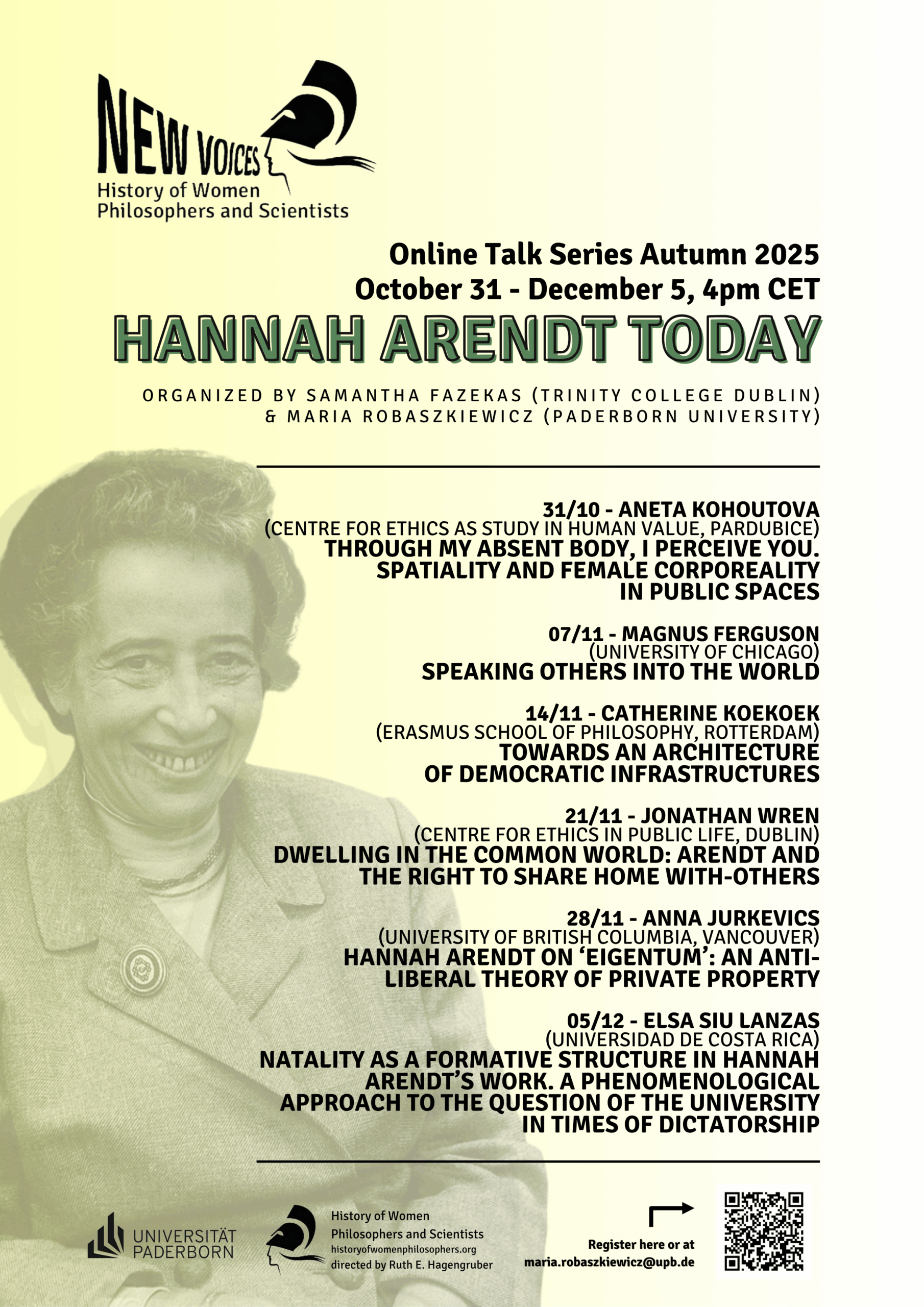
New Voices – Magnus Ferguson: Speaking Others into the World
Talk | 4:00 PM - 6:00 PM |
Abstract: In certain contexts unreciprocated speech can be an important form of care for persons who would otherwise find it difficult to retain their place in shared worlds of linguistic meaning, such as those who lose capacities for linguistic expression due to illness. Philosophers and political theorists often underscore the importance of reciprocated speech for sharing in a human world. Hannah Arendt makes this point especially forcefully in The Origins of Totalitarianism and The Human Condition, in which she suggests that ‘speechless’ persons are excluded from the linguistic ‘web of relationships’—they are, she writes, ‘literally dead to the world.’ I reconstruct several of Arendt’s analyses of speech and speechlessness, and argue that they are prima facie exclusionary to nonspeaking persons. I also identify resources in Arendt’s corpus for theorizing unreciprocated speech as a mode of care that can offer listeners footholds in the linguistic spheres of meaning around them.
Magnus Ferguson (Ph.D.) is a Collegiate Assistant Professor at the University of Chicago and a Harper-Schmidt Fellow in the University of Chicago Society of Fellows. He received his Ph.D. in Philosophy from Boston College in 2023, and his B.A. in Religion from Columbia University in 2014.
More about the New Voices Winter Term Talk Series 25: https://historyofwomenphilosophers.org/new-voices-talk-series/
 share
share tweet
tweet