



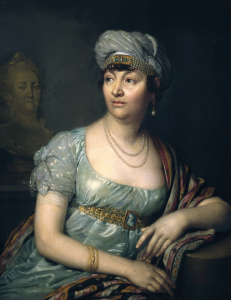
 The Erasmus University Rotterdam hosts the workshop “Germaine de Staël, Women’s Scholarship, and Intellectual History”, bringing together scholars to discuss Staël’s philosophical work, her role in intellectual history, and the broader project of rethinking the canon.
📅 Saturday, 18 April 2026
🕘 09:30–16:30
🗣️ Seminar (in English)
📍 Erasmus University College, Lecture Hall A, Nieuwemarkt 1A, Rotterdam
🎓 With contributions by Sandrine Bergès, Ada Bronowski, Kristin Gjesdal, Helena Rosenblatt, and a panel featuring Ruth Hagengruber and Alicia Montoya.
The event is organised on the occasion of the PhD defence of Eveline Groot, who will defend her dissertation Reason and the Passions in the Philosophy of Germaine de Staël on April 17 (13:00, Erasmus University Rotterdam). Further information about the Workshop: https://www.eur.nl/en/esphil/events/germaine-de-stael-womens-scholarship-and-intellectual-history-2026-04-18
 This perspective is further explored in the Springer volume Teaching Women Philosophers. In her chapter, Eveline Groot analyses Staël’s De l’influence des passions sur le bonheur des individus et des nations (1796), showing that emotionality and rationality are not opposites, but mutually constitutive elements of moral and political life:
Germaine de Staël’s theory of the impassioned nature of human beings, as set out in her work De l’influence des passions sur le bonheur des individus et des nations (1796), provides an insightful account of a sentimentalist theory in which human sensibility and emotionality are understood to be a core part of moral thought. In this work, Staël develops a psychological anthropology and moral theory that presents an interplay between the rational and the sentimental as one of its core aspects. Understanding the impassioned nature of human beings is crucial if—like Staël—one believes that passions are the most important root from which individual and collective happiness sprout. Furthermore, passions are essential for moral judgement: in the complex human psychology, dual negative and positive influences of both reason and the passions influence each other. This interplay functions on a political and public level as well as on a personal and private level.
#WomenInPhilosophy #IntellectualHistory #GermaineDeStael #Philosophy #Workshop #TeachingWomenPhilosophers
You cannot copy content of this page