


The Center for the History of Women Philosophers and Scientists has a long-standing partnership with the German Society for Philosophy (DG Phil). In 2025, the German Society for Philosophy elected Prof. Dr. Ruth Edith Hagengruber as its new president. Below, you will find a selection of events and news about this collaboration.
-
President of the DGPhil
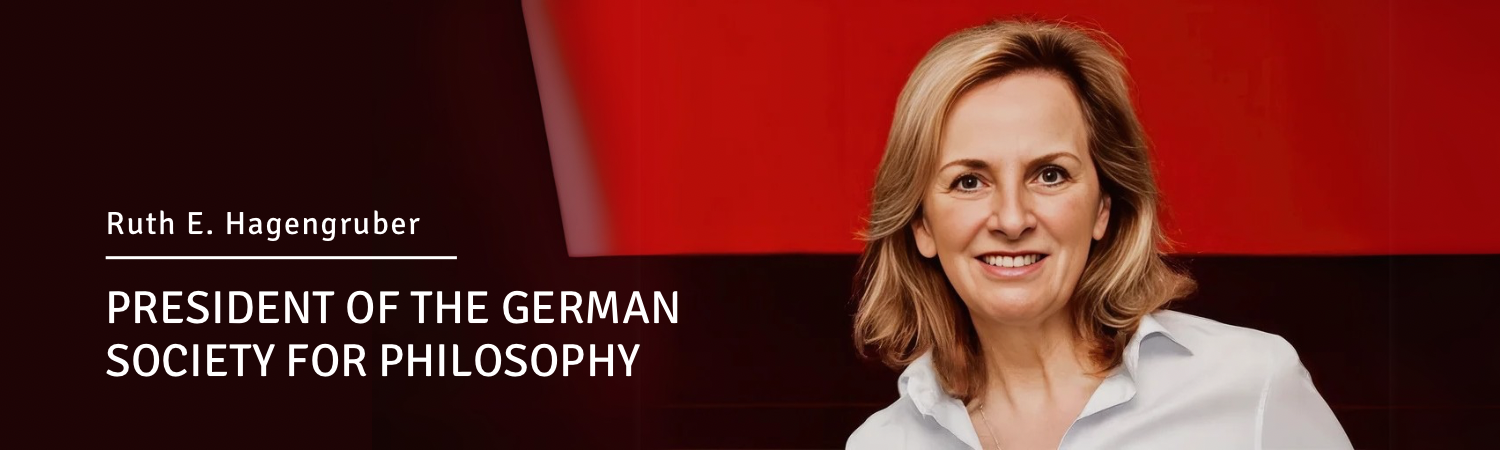
Prof. Dr. Ruth Edith Hagengruber elected President of the German Society for Philosophy (DGPhil)
Ruth Edith Hagengruber, Professor of Philosophy at the University of Paderborn, is the first woman to be elected President of the German Society for Philosophy.
Germany has a rich philosophical tradition that has profoundly shaped Western thought: Notable figures such as Hildegard von Bingen, Elisabeth of Bohemia, Immanuel Kant, Karl Marx, Edith Stein and Hannah Arendt are among those who have contributed to this legacy. Germany has also been the birthplace of major philosophical movements, including German Idealism, Phenomenology, Existentialism. The present author’s research focuses on exploring the legacy of women philosophers.
Ruth Edith Hagengruber asserts that the critical examination of the philosophical tradition is furthered by the thought of women philosophers. The study of women philosophers, she asserts, serves as a conduit for the evolution of thought and the acquisition of novel perspectives on well-established subjects. The expansion of knowledge is a fundamental aspect of shaping the future.
In order to further expand upon this perspective, we inquired about her current views on the prevailing political climate. Is the attack on the principles of academic freedom also an attack on the emancipation of women?
‘This backlash follows a period of liberal politics that was both productive and long-lasting. This phase was characterised by the dissolution of boundaries and the overcoming of intellectual barriers, including continental and racial boundaries. This phenomenon of backlash has occurred repeatedly throughout history,’ says Hagengruber. ‘We will refrain from involvement in political matters, yet we will articulate the philosophical insights with utmost clarity,’ asserts Hagengruber.
The president is supported in this endeavour by the vice president, Gerald Hartung, a cultural philosopher and professor at the University of Wuppertal, and by the business philosopher Ingrid Becker from the Ruhr-University Bochum. The school department is to be overseen by Kevin Dear, while Christian Barth has been appointed to the role of finance director.
-
75 Years DGPhil 20.11.2025
Thinking Europe Anew – 75 Years German Society for Philosophy
1950-2025
Seventy-five years ago, Germany was admitted to the Council of Europe. The German Society for Philosophy was also founded 75 years ago. We are celebrating this anniversary with our event: Thinking Europe Anew.
The Council of Europe’s ideals of the rule of law, human rights and democracy are the result of centuries of controversy. The European idea and the values it represents cannot be understood without reference to the great European philosophical tradition.
The motto of the event celebrating the 75th anniversary of the German Philosophical Society is therefore to reconsider Europe’s philosophical tradition in light of current challenges.The event took place on November 20, 2025, at Paderborn City Hall.
Ceremonial Adresses on Youtube:
 “Europa neu denken. 75 Jahre Deutsche Gesellschaft für Philosophie” Prof. Dr. Ruth Edith Hagengruber, President of the German Society for Philosophy; Director of the Center for the History of Women Philosophers and Scientists.
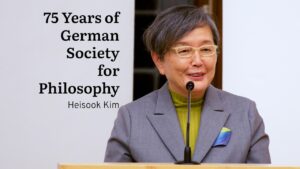 “75 Years of German Society for Philosophy” Prof. Dr. Heisook Kim, President of the International Federation of Philosophical Societies; Professor emerita Ewha University, Seoul, South Korea.
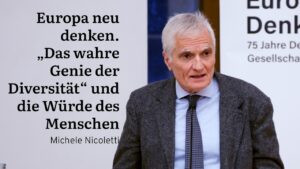 “Europa neu denken. „Das wahre Genie der Diversität“und die Würde des Menschen” Prof. Dr. Michele Nicoletti, Director of the School of International Studies, Professor of Political Philosophy at the School of International Studies, Trient, Italy.
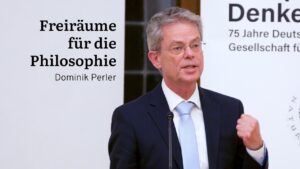 “Freiräume für die Philosophie” Prof. Dr. Dominik Perler, Professor of Philosophy, Humboldt- University; former President of the German Society for Philosophy, Berlin, Germany.
Interviews 75 Years DGPhil on YouTube:
YouTube Playlist here.
-
Philosophers4Europe
 Philosophers4Europe_Thinking_Europe_Anew
Philosophers4Europe brings together philosophers and intellectuals. It aims to thinking Europe anew as a space of thought and a space of ideas. It defines Europe as an ongoing political and intellectual endeavour.
We are committed to defending freedom of thought, critical inquiry, and open debate against all forms of dogmatism, authoritarianism, discrimination, and indifference. We seek to promote a vibrant civil society and to foster a shared sense of responsibility for Europe’s future.
Philosophers4Europe is an open initiative. We invite all who share these ideas with us to join the group.
The initiative was founded by Ruth Edith Hagengruber, President of the German Society for Philosophy and Michele Nicoletti, Coordinator of the Open Council of Europe Academic Network OCEAN.
Follow Philosophers4Europe on LinkedIn here.
Recent Project Group Meetings:
21.11.2026 Paderborn University, Center for the History of Women Philosophers and Scientists (HWPS) | By invitation of Prof. Dr. Ruth Hagengruber, President of the German Society for Philosophy (DGPhil)
26.06.2026 Rome, Italy | By invitation of Prof. Dr. Michele Nicoletti, in cooperation with CeSPI
-
In memoriam Jürgen Habermas
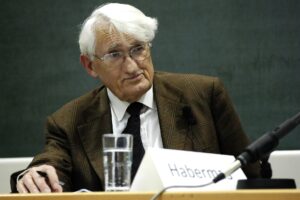
Wolfram Huke, 2008, Wiki Commons. https://commons.wikimedia.org/wiki/File:JuergenHabermas.jpg
Europe and its great enlightener. In memoriam Jürgen Habermas.
– Obituary by Prof. Dr. Ruth Edith Hagengruber
My first official act as President of the German Society for Philosophy was to congratulate Jürgen Habermas on his birthday and ask if he would be willing to deliver the keynote address at the 75th anniversary celebrations of the German Society for Philosophy, ‘Rethinking Europe’. The question of the future of Europe, which Habermas had so often grappled with, had become acutely relevant in a new way towards the end of his life.
Habermas did not come. My birthday letter made me feel downright uncomfortable, for it must have reached Habermas in the very days when his wife had passed away. Absent yet present, the history of German philosophy – and of German philosophy in relation to European philosophy – could not be told without Habermas. Michele Nicoletti, the keynote speaker at the event, refers to Habermas when he calls for a European public sphere composed of an integrated European civil society, supranational movements and associations. Habermas criticised the French left for rejecting the European Constitution. Habermas called for the formation of a European political consciousness, whilst others invoked the common economy, technology and the common military as evidence of European unity. Nicoletti’s question as to how European citizenship recognises itself as such led him to the characteristics Habermas continued to unearth from the legacy of the European Enlightenment, even though they were not to be found there at all: plurality, freedom and justice.
These well-meaning narratives and their fractures had already prompted the all-American philosophers, as early as 1947 at that memorable congress, to ask what would now become of Europe, given that it lay in ruins. Contrary to predictions, German philosophy was not entirely extinct. The triumvirate of Arendt, Adorno and Habermas kept the Enlightenment alive, albeit with quite different conceptions of it. The youngest of the three, who himself said he had learnt much from Arendt, surpassed her in his emphatic assessment that the French Enlightenment was the era of cafés and salons and the emergence of citizens public life.
Yet the Enlightenment is over. Freedom and equality have lost their home in Europe. Colonialism and the Holocaust showed that Europe had failed in its own aspirations. This accusation now dominates the debate against Europe. Europe’s failure became the turning point for new global aspirations, from Russia to China and Africa. As recently as 2013, the Arab elite still wanted to let the Enlightenment shine; now it, too, seems to be pouring scorn on Europe’s weakness.
Habermas remained true to his programme. Whereas American philosophy in 1947 declared the end of European values, Habermas countered in 2003 that the American claim to normative authority had failed and called for “the rebirth of Europe”. For this he was heavily criticised (FAZ 31 May 2003). His speech in 2013 at the World Philosophy Congress in Athens seemed out of step with the times, as he invoked this history once more, whilst the Chinese delegation had long since been celebrating Confucianism as the new normative force of the future.
Habermas’s euphoria for Europe demanded for European unity even with ‘compulsion`, holding that The nation-state, too, had once been imposed on Europeans. Even back then, Germans were not friends to other Germans, Poles were not friends to other Poles, and the French were not friends to all French people. What became possible through the 19th-century narrative of the nation-state – and which today hinders us – must and can succeed in Europe, “overcome our national narrow-mindedness.” (The Divided West 2004, 64 ff.)
Today, the theory of communicative action appears romantic. Arendt had always advocated for a diversity of voices within pluralism and considered consensus unsuitable for democracy. Habermas, on the other hand, maintained that it was through consensus that unity was to be achieved—a longing, albeit steeped in rationality, that had remained with him from his early studies of Schelling.
His discourse ethics was consensus-oriented and blind to the fact that rational agreement shattered against the will to power. He announced an ‘unforced force’, a voluntary submission to reason. But this dream of reason failed at the very latest where it could offer the aggressor nothing but a ‘face-saving compromise’ (SZ 15.2.23). Habermas could not and would not recognise that his theory was unsuited to overturning power relations. Thus, he remained blind to feminism as well. Transforming the primacy of the male-dominated lifeworld into a community of equals through rational communication was not a concern of his.
The last of the Enlightenment thinkers has now passed away. He leaves behind an empty space that must be filled.
Ruth Edith Hagengruber March 14, 2026
President of the German Society for Philosophy
Image: Wolfram Huke, 2008, Wiki Commons. -
Talk Series "Die großen Kontroversen"
Talk Series “Die großen Kontroversen. 75 Jahre Deutsche Gesellschaft für Philosophie”
07.08.2026 Interview with Assoz. Prof. Dr. Bettina Bussman and Dr. Elisabeth Widmer “Canon Pluralism”
Prof. Dr. Bettina Bussman Biography:
Bettina Bussmann is Professor of Philosophy at the University of Salzburg. Her research focuses on philosophy of education, philosophy didactics, epistemology, and philosophy of science. After a period working as a teacher of philosophy and psychology, she returned to academia, completing her doctorate in 2013 and her habilitation in 2019. She advocates a research-oriented approach to philosophy didactics that combines philosophical reflection with empirical findings and understands philosophical education as a contribution to well-grounded judgment.
She is the editor of several book series, including Philosophische Bildung in Schule und Hochschule (Springer VS). She is also editor of the Zeitschrift für Didaktik der Philosophie und Ethik, which will be published open access from 2027 onwards. Since 2023, she has been a Key Researcher in the Cluster of Excellence Knowledge in Crisis (knowledgeincrisis.com). Her work there addresses, among other topics, questions concerning the role of knowledge, expertise, and rationality in pluralistic societies.
Publications by Bettina Bussmann:
Pitzer, S. / Bussmann, B. Methodische Konzepte für den Philosophie- und Ethikunterricht. Eine empirische Analyse zum Theorie-Praxis-Transfer. Springer, forthcoming 2026. Open Access.
Bussmann, B. (ed.). Philosophieren mit Kindern und Jugendlichen. Grundlagen – Methoden – Praxis. Springer, 2024.
Bussmann, B. “Warum lebensweltlich – wissenschaftsorientiertes Philosophieren nicht nur in der Schule notwendig ist. Bildungsphilosophische Legitimation, Klärung von Missverständnissen und ein Anwendungsbeispiel.” In: Christian, A. / Gawel, I. (eds.), Wissenschaftsleugnung – Fallstudien, philosophische Analysen und Vorschläge zur Wissenschaftskommunikation. De Gruyter, 2024. https://doi.org/10.1515/9783110788341-010
Dr. Elisabeth Widmer Biography:
Elisabeth Widmer is an Assistant Professor at Rice University in Texas, USA. Her research focuses on Left-Kantian currents in the early twentieth century. In this context, she revitalizes a philosophical approach that places political and legal cognition at its centre and understands the critique of ideology as a defining feature of social democracy.
She is also co-editor of the academic journal Kantian Review and serves on the American Philosophical Association’s Committee on Inclusiveness in the Profession. In addition to her historical and systematic research, she is deeply engaged with the question of how the history of philosophy can be taught in ways that critically reflect upon and challenge the historical biases of the canon.
Publications by Elisabeth Widmer
Elisabeth Widmer works on Left-Kantianism and has published several articles on the subject, as well as a monograph on the topic with De Gruyter. One of the articles we will discuss today is entitled “Addressing Controversial Ideas in Philosophy Class: A Critical-Hermeneutical Lens,” published in Educational Philosophy and Theory in 2025 and available on her personal website.
15.07.2026 Interview with Prof. Dr. Michaela Haase and Prof. Dr. Ute Schmiel on the “Positivism Debate”
Prof. Dr. Michaela Haase Biography:
Michaela Haase is an Adjunct Professor in the Marketing Department at Freie Universität Berlin. She studied Political Science, Philosophy of Science, and Economics at Freie Universität Berlin. She received her doctorate with a dissertation entitled Galilean Idealization: A Pragmatic Concept. Her habilitation focused on Institutional Economics in Business Administration: General Business Administration Based on Social and Institutional Theory.
She is co-editor of the Zeitschrift für Wirtschafts- und Unternehmensethik (zfwu), Associate Editor of the Journal of Macromarketing, and a member of the Editorial Board of the International Journal of Ethics and Systems. She is also co-editor of the book series Studies in Economic Ethics and Philosophy and serves on the advisory board of Studies in Philosophy of Economics / Studien zur Wirtschaftsphilosophie. In addition, she has served as a guest editor for several academic journals, including the Journal of Business Ethics, the Zeitschrift für Wirtschafts- und Unternehmensethik(zfwu), the Journal of Philosophical Economics, and the Journal of Business Economics.
She has received several grants and awards, including the Robert A. Mittelstaedt Award from the Macromarketing Society in 2015. Between 2018 and 2025, she led two research projects funded by the German Research Foundation (DFG) on Social Value and Social Enterprise, and on Value and Valuation. She currently serves as Chair of the Working Group for Philosophy and Ethics of Economics within the German Society for Philosophy (DGPhil).
Publications by Michaela Haase:
Marketing, Ethics and Sustainability: A Value-Cocreation Perspective. Tübingen: UVK.
“Socioeconomic Coordination: Toward an Epistemic-Ethical Visible Hands Approach.” ORDO.
https://doi.org/10.1515/ordo-2025-2044“The Nexus of Knowledge, Action, and Values, and the Philosophical, Social, and Normative Foundations of Marketing.” Journal of Macromarketing, 45 (1), 130–145.
“Prerequisites for the Positioning of Scientific Disciplines: An Analysis Considering Values, Norms, and Science-Related Issues.” Perspectives on Science, 33 (1), 1–37.
“Erkundung, Positionierung und Konsolidierung einer philosophischen Disziplin” (with Susanne Hahn, Ludger Heidbrink, Matthias Kettner, Birger P. Priddat, and Peter Seele). Zeitschrift für Wirtschafts- und Unternehmensethik(zfwu), 23 (2), 292–306.
Prof. Dr. Ute Schmiel Biography:
Prof. Dr. Ute Schmiel has held the Chair of Business Taxation at the University of Duisburg-Essen, Essen Campus, since 2008. Her research focuses on the economic analysis of tax law and related ethical and epistemological questions in business administration. She is a member of the editorial board of ORDO: Jahrbuch für die Ordnung von Wirtschaft und Gesellschaft and Chair of the Scientific Commission for Economic Theory and Ethics in Business Administration within the Association of University Professors of Management (VHB).
Publications by Ute Schmiel:
Schmiel, Ute. “Wealth Taxation on Individuals and Equity: A Political-Cultural Market Theory Perspective.” Critical Perspectives on Accounting, 99.
https://doi.org/10.1016/j.cpa.2022.102465Sander, Hendrik; Scherer, Anna-Lena; Schmiel, Ute. “The Arm’s Length Principle – An Adequate Means for Taxing Multinational Corporate Groups?” Accounting, Economics, and Law: A Convivium.
https://doi.org/10.1515/ael-2023-0018Schmiel, Ute. “Why Tax Planning Without Considering Societal Interests is Unfounded.” Accounting, Economics, and Law: A Convivium.
https://doi.org/10.1505/ael-2021-011522.07.2026 Interview with Prof. Dr. Reinold Schmücker on the “Just War”
Prof. Dr. Reinold Schmücker Biography:
Univ.-Prof. Dr. Reinold Schmücker is Professor of Philosophy at the Department of Philosophy at the University of Münster. He studied Philosophy, German Studies, and Protestant Theology in Tübingen and Hamburg, where he received his Magister degree in 1991 and completed his doctorate in 1997.
Before his appointment to the University of Münster in 2009, he held various academic positions, including Research Assistant at the University of Hamburg and Managing Director of the Alfried Krupp Wissenschaftskolleg Greifswald. His research focuses on aesthetics and philosophy of art, cultural philosophy, ethics, and political philosophy.
In addition to his academic work, Schmücker is actively involved in academic self-governance and the wider philosophical community. He has served as Dean of his faculty, was President of the German Society for Philosophy (DGPhil) from 2022 to 2025, and currently serves as spokesperson for the Research Group Access to Cultural Goods in the Digital Transformation. He is also co-editor of the Zeitschrift für Ästhetik und Allgemeine Kunstwissenschaft.
-
Ehrenpromotion Prof. Dr. Dr.h.c. C.F. Gethmann
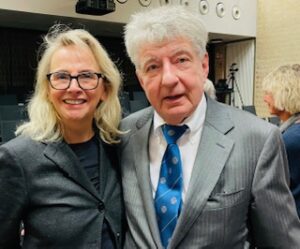
Photo: Michael Quante
Ehrenpromotion Prof. Dr. Dr.h.c. C.F. Gethmann
By Ingrid Becker:
The University of Münster is honouring the philosopher and former President of the German Society for Philosophy (DGPhil), Professor Dr. Dr. h. c. Carl Friedrich Gethmann, for his life’s work. Gethmann, who was awarded an honorary doctorate by the Department of History and Philosophy on Friday, 24 October 2025, has uniquely combined in his work the reflection on fundamental and methodological questions within his discipline with the practical application of philosophical expertise in policy advice and public discourse.
The emeritus professor of the University of Duisburg-Essen is being honoured for his groundbreaking contributions to logic, philosophy of science, philosophy of language, metaphysics, epistemology, and ethics, as well as for his exemplary work in Applied Philosophy, which is regarded as a hallmark of the Münster Institute of Philosophy. In addition to Gethmann’s work in philosophy in the narrower sense, the Department therefore also highlights his politically influential contributions to the ethics of science, medical ethics, environmental ethics, technology assessment, and risk assessment. Even after his retirement, the philosopher continues to engage with current issues in these fields with great dedication.
The laudatory address was delivered by Münster philosopher Oliver R. Scholz. Carl Friedrich Gethmann subsequently expressed his gratitude for this rare honour by giving a lecture entitled “On Two Concepts of ‘Possibility’.”
-
DGPhil on Social Media
The German Society for Philosophy on Social Media:
Connect with the DGPhil and gain insights into current developments and a wide range of topics from our working groups and beyond.
DGPhil on Instagram:
https://www.instagram.com/dgphil_ev/
DGPhil on LikedIn:
https://www.linkedin.com/company/37140853
DGPhil on YouTube:
https://www.youtube.com/@DGPhil
DGPhil on Facebook:
https://www.facebook.com/dgphil.offiziell

You cannot copy content of this page