



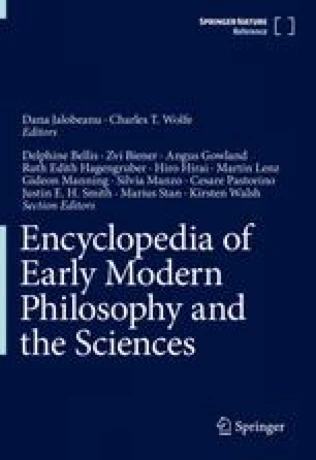
 Discussing the historiography of women philosophers, Ruth E. Hagengruber shows that women thinkers of the early modern period were themselves engaged in reflecting on how women’s intellectual achievements should be documented and remembered:
“Gottsched, and Brucker, in his History of the most excelling men, published between 1740 and 1750, distances itself from a kind of praise that became useless ‘as each woman is called a Minerva,’ as Luise Gottsched mentions. Brucker includes as ‘excellent’ Du Châtelet, Laura Bassi, and Luise Gottsched, holding that there were excellent women ‘in all nations and at all times’ (Hagengruber 2018).” ~ (Hagengruber, 2022, p. 2214)
Read the full encyclopedia entry here:
Edited by Dana Jalobeanu (University of Bucharest) and Charles T. Wolfe (Université Toulouse–Jean Jaurès), the encyclopedia offers a comprehensive re-examination of the formation and foundations of philosophy and science in early modern Europe. Bringing together more than one hundred scholars from the fields of philosophy, history of science, history of medicine, and intellectual history, the volume challenges traditional narratives and explores overlooked actors, marginalized voices, gender perspectives, and the complex interactions between scientific practices and philosophical thought.
Ahead of the Center’s tenth anniversary celebration this summer, Hagengruber’s contribution highlights a mission that has guided the Center since its foundation: making visible the intellectual achievements of women philosophers and scientists and restoring their place in the history of ideas. Interested in celebrating with us? Join us this summer here: https://indico.uni-paderborn.de/event/157/
You cannot copy content of this page