


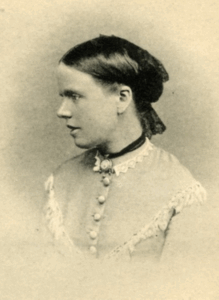
 Frances Julia Wedgwood
British philosopher, essayist, and intellectual historian
*February 6, 1833
†November 26, 1913
Julia Wedgwood was a member of the prominent Darwin–Wedgwood family and a niece of Charles Darwin. She was educated mainly at home and then studied university-level classes at Bedford College, London, in subjects including logic, Greek, ethics, and political economy. She could read French, German, Greek, Latin, Italian, and Hebrew.
After initially publishing two well-received novels in 1858, she changed course and began to publish non-fiction, beginning with a two-part dialogue about evolutionary theory and religion. She went on to publish well over a hundred journal articles on topics spanning the theory of language, science and faith, free will and determinism, philosophy of art and literature, the self, utilitarianism and other ethical theories, Hegel, the metaphysics of nature, and Greek and Roman philosophy. She was a feminist and supporter of female suffrage, and a vocal champion of animal welfare.
Her intellectual work culminated in her 1888 major work The Moral Ideal, a history of changing conceptions of the good across different civilisations, from ancient India through to modern Europe. She adopted a dialectical approach, treating each civilisation as having internal conflicts that led to the next one, powering what she called our ‘zig-zag’ ascent of the ‘mountain of truth’.
Wedgwood’s other full-length books were a biography of John Wesley, an account of the moral contributions of Judaism in The Message of Israel, a second edition of the Moral Idealthat included ancient Egypt, and a collection of a handful of her journal articles, Nineteenth-Century Teachers. When she died she was working on a biography of her ancestor, the potter Josiah Wedgwood.
-
Primary Sources
Books:
John Wesley and the Evangelical Reaction of the Eighteenth Century. London: Macmillan, 1870.
The Moral Ideal: A Historic Study. London: Trübner.
The Moral Ideal: A Historic Study. New and revised edition. London: Kegan Paul, Trench, Trübner, & Co., 1907.
Nineteenth-Century Teachers and Other Essays. London: Hodder & Stoughton, 1909.
The Personal Life of Josiah Wedgwood, the Potter. London: Macmillan, 1915; completed posthumously by Charles Herford.
Essays:
Since Wedgwood wrote more than 120 journal articles, this list is only indicative.
‘The Boundaries of Science’. Parts I and II, Macmillan’s Magazine 2 (June 1860), 134–38, and 4 (July 1861), 237–47.
‘The Origin of Language’. Westminster Review 30 July 1866, 88–122.
‘Female Suffrage, Considered Chiefly with Respect to its Indirect Results’. in Woman’s Work and Woman’s Culture, ed. Josephine Butler, 247–89. London: Macmillan, 1869.
‘Hume and the Positive Philosophy’. Spectator 4 April 1874, 434–37.
‘Hume and the Utilitarian Ethics’. Spectator 11 April 1874, 468–70.
‘Mr Sidgwick’s Methods of Ethics’, first and second notice, Spectator 13 March 1875, 341–44, and 20 March 1875, 374–76.
‘The First Opponent of Christianity’. Spectator, 30 March, 1878, 408–10.
‘A Dialogue on Fate and Free-Will (After Berkeley)’. Parts I and II, Spectator 11 January, 1879, 45–47, and 18 January, 1879, 79–81.
‘Aristotle on Free-Will’. Parts I and II, Spectator, 24 July 1880, 941–43, and 31 July 1880, 971–73.
‘The Moral Influence of George Eliot’. Contemporary Review 39 (February 1881), 173–85.
‘Moral Purpose in Fiction’. Spectator, 25 March 1882, 388–90.
‘Pleasure and Pain’. Spectator, 16 September 1882, 1194–96.
‘The Misleading Character of Law as an Index to Morals’. Spectator, 29 September 1883, 1247–49.
‘Aeschylus and Shakespeare: The “Eumenides” and “Hamlet”‘. Contemporary Review 49 (January 1886), 83–91.
‘Woman and Democracy’. The Woman’s World 1 (June 1888), 337–40.
‘“Male and Female Created He Them”‘. Contemporary Review 56 (July 1889), 120–33.
‘Ethics and Literature’. Contemporary Review 71 (January 1897), 63–80.
‘Ethics and Science’. Contemporary Review 72 (August 1897), 219–33.
-
Secondary Sources
Brown, Sue (2012) ‘Robert Browning and Julia Wedgwood: The Unpublished Correspondence’, Journal of Browning Studies 3: 29-52.
Brown, Sue (2023) Julia Wedgwood, the Unexpected Victorian: The Life and Writing of a Remarkable Female Intellectual. London: Anthem Press.
Brown, Sue (2024) ‘Julia Wedgwood, a Victorian Feminist and Female Intellectual’, Women’s History Review 30, no. 2: 244–64.
Malone, Katherine (2009) The Lady Critic: Women of Letters and Critical Authority in British Periodicals, 1854-1908. PhD thesis, Temple University.
Marshall, Madison (2022) Reading Kinship: Intellectual influence, authorial formation, and the father-daughter relationship of Hensleigh and Julia ‘Snow’ Wedgwood. PhD thesis, University of Leeds.
Schaefer, Donovan (2017) ‘The Science of Life’ in The Oxford Handbook of Nineteenth-Century Christian Thought, ed. Joel Rasmussen, Judith Wolfe and Johannes Zachhuber. Oxford: Oxford University Press.
Stevens, L. Robert (1998) ‘Intertextual Constructions of Faith: Julia Wedgwood (1833-1913)’, in Women’s Theology in Nineteenth-Century Britain, ed. Julie Melnyk. New York: Garland.
Stone, Alison (2023) Women Philosophers in Nineteenth-Century Britain. Oxford: Oxford University Press.
Stone, Alison (2024) ‘Julia Wedgwood and the Origin of Language’, Intellectual History Review 34, no. 4: 751–772.
Wedgwood, Barbara. 1983. A Critical Study of the Life and Works of Julia Wedgwood. PhD thesis, University College London.
-
Online Sources
‘Julia Wedgwood’, Darwin Correspondence Project.
Rachel Kilgore, ‘A Wonderful Variety of Mud’, Baylor University blog.
Samantha Evans, ‘Julia Wedgwood’s Pamphlet on Female Suffrage‘, 1584 blog.
Jose Harris, ‘Julia Wedgwood’, Oxford Dictionary of National Biography.
Alison Stone, ‘Julia Wedgwood (1833-1913)’, a tribute, Pascal Theatre Company.
-
ECC
-
Media
-
Projects
The Julia Wedgwood Site is a website dedicated to her writings and thought. It provides a long and growing bibliography of her writings, with her numerous periodical essays available to read. In addition to several books, she published well over a hundred essays.
Many of these essays were originally published anonymously, because anonymity was the norm in nineteenth-century British journals, for men and women alike. This convention of anonymity presents a challenge today – how do we know which essays were written by women? The Julia Wedgwood site explains how digital, textual, and archival methods can be combined to identify her writings.
-
Quotes
You cannot copy content of this page