




Women Philosophers Heritage Collection
The Women Philosophers Heritage Collection presents a comprehensive and significant selection of writings from women in the history of philosophy and science since antiquity. Publications include a contemporary English translation, annotations, and introductions on the author, the work, its context, and its methodology; if available, the original language version will also be published. Furthermore, the introductory commentary contextualizes the significance of the work in its time and beyond in the history of philosophy. A comprehensive list of literature on author and text provides additional valuable information.
The volumes are indispensable resources for all interested in the history of philosophy—the novice as well as the researcher in women philosophers. The books will contribute to include women philosophers in the philosophy and humanities canon.
-
(2023) Metaphysical Conversations and Phenomenological Essays
Gschwandtner, C. (2023). Metaphysical Conversations and Phenomenological Essays. De Gruyter.
ISBN: 9783110763065
This is the first translation into English of early phenomenologist Hedwig Conrad-Martius’ Metaphysical Conversations, originally published in 1921. Conrad-Martius was one of Husserl’s first students, an important part of the Göttingen Phenomenology Circle and mentor to Edith Stein, Jean Héring, and other early phenomenologists. The present volume provides the full German and English texts of the conversations, a phenomenological discussion of the nature of the human, examining the nature of body, soul, and spirit, and drawing distinctions between plants, animals, humans, and various other beings. The volume also includes two important essays on phenomenology, in which Conrad-Martius distinguishes between the phenomenological approaches of Husserl, Heidegger, and the more ontological approach of the Göttingen school of phenomenology. She is critical of Husserl’s “transcendental” and Heidegger’s “existential” approach. The conversations illustrate her use of the phenomenological method for fundamental investigations into the nature (or Wesen) of things.
-
(2024) On Body, Soul, and Spirit
Gschwandtner, C. (2024). On Body, Soul, and Spirit: Phenomenological and Ontological Investigations. De Gruyter.
ISBN: 9783110761528
This is the first translation into English of two texts by the early phenomenologist Hedwig Conrad-Martius, who was one of Husserl’s first students, an important part of the Göttingen Phenomenology Circle and mentor to Edith Stein, Jean Héring, and other early phenomenologists. The present volume provides the full German and English texts of two lectures, originally published under the title “Bios und Psyche” in 1949, which discuss the nature of life as it is expressed differently in plants, animals, and humans. Conrad-Martius is in explicitly conversation with the scientific research of her time period, providing a deeper philosophical grounding for its ontological claims. The second text was originally published as “Die Geistseele des Menschen” in 1960 and presents her mature view of the human soul and spirit, including their relationship to each other and to the human self.
-
(2024) Phenomenology of Mysticism
Calcagno, A. (2024). Phenomenology of Mysticism. De Gruyter.
ISBN: 9783110763089
Mystical experience continues to fascinate human beings across different cultures and traditions. Deploying the phenomenological method, Gerda Walther’s Phenomenology of Mysticism explores the conditions that make mystical experience possible, that is, how it is that human beings make sense of mystical phenomena. Unlike historical and anthropological sudies of mysticism across cultures, Walther maintains that to phenomenlogically grasp the sense of mystical experience certain conditions must obtain: All encounters with a living divinity require the relating subject to be configured as a human person consituted as a lived unity of body, psyche, and what Gerda calls a fundamental essence or spirit. Without such a configuration of the human person, unique intersubjective experiences with a divinity prove impossible. For Walther, such personal relations lay the ground for human interiorty to encounter God and the uniqueness of God to become manifest to human beings. Without Walther’s personal structure, encounter with and understanding what a divinity reveals cannot be expereinced. Walther presents the subjective and intersubjective elements that make mystical experience possible.
-
(2025) Gerda Walther. Toward an Ontology of Social Communities
 Luft, S. & Parker, R. (2025). Gerda Walther. Toward an Ontology of Social Communities: With an Appendix on the Phenomenology of Social Communities. De Gruyter.ISBN: 9783110764857
This is the first full-text English translation of a seminal book within the phenomenological movement.
The work was orginally published in 1922 in Edmund Husserl’s yearbook Jahrbuch für Philosophie und phänomenologische Forschung, and has had a wide impact on work in phenomenology (Husserl, Heideger, Stein) and social ontology. Gerda Walther broaches the topic of social ontology, i.e., a study of social communities. She carries out this task by using the phenomenological method, that is, a study of the first-person (both singular and plural) experience of being a part of a community, what it feels like internally (and its constitutive elements), how it relates to other individuals or other communities, and how unifications between individiuals and communities or between communities take place.
The book is an important contribution to the phenomenology of intersubjectivity or the study of social ontology. Social ontology has been an important and fruitful field of research in contemporary social theory, cognitive science, and other disciplines. It will be a crucial contribution to current research.
- Pioneering study of the nature of the social world
- Author was student of Edmund Husserl
- Important work of early phenomenology
-
(2026) A Manual for the Freest Spirits
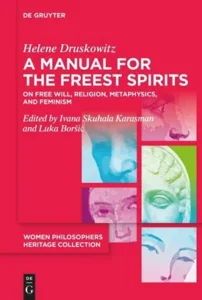 Druskowitz, H., Boršić, L. & Skuhala Karasman, I. (2026). A Manual for the Freest Spirits: On Free Will, Religion, Metaphysics, and Feminism. De Gruyter.
ISBN: 9783119148757
Helene Druskowitz (1856–1918) was the first German-speaking women to acquire a PhD in philosophy. She explored free will, religion, metaphysics, and feminism. In the four small books presented in this volume, she discusses previous attempts to replace religion (esp. Comte, Mill, Feuerbach, Lange, Nietzsche, Duboc, Düring, and Salter), advocates replacing religion with knowledge-based worldviews, proposes a dualism between matter and transcendent reality, and argues for moral responsibility without free will.
The book includes the English translations, a comprehensive introduction, and the German text.
As a radical feminist, Druskowitz advocated for gender segregation and women-led societal reform, even proposing human extinction as a moral imperative. Her ideas on male dominance and environmental degradation anticipated later eco-feminist thought. Though not widely recognized in her time, Druskowitz’s work offers valuable insights into feminist philosophy, eco-feminism, and discussions on free will and criticisms of religion, providing historical context for these ideas’ evolution in the 20th and 21st centuries.
-
(2027) Hindu Women's Education and Its Progress
-Forthcoming-
Devi, K. & Chakraborty, S. (2027). Hindu Women’s Education and Its Progress. De Gruyter.
ISBN: 9783111313481
Kailashbasini Devi’s late 19th century works provided a pathbreaking account of the condition of women in colonial Bengali under Hindu Brahminic patriarchy. This book offers the first English translation of The Miserable Condition of Hindu Women and Hindu Women’s Education and Its Progress. The works show the author’s social imagination of a gender-just society, her reformative ideas of conjugality and her conception of women’s education.
- First English Translation
- Pathbreaking account of women’s living in a Hindu-Brahminic patriarchy
- Detailed depiction of future gender-just society
-
(2027) The Travel Writings: London Yatra and London Jubilee
-Forthcoming-
Hardevi, S. & Minocha, A. (2027). The Travel Writings: London Yatra and London Jubilee. De Gruyter.
ISBN: 9783111453385
London Yatra (1888) and London Jubilee (1888) are translations of travel accounts written by Hardevi, who travelled from Lahore in Punjab to London to witness Queen Victoria’s Jubilee in 1887. Hardevi’s writings, that have been buried in the archives, encode her sense of the ‘modern’ self through a journey to the heart of the empire as well as through a literary journey of writing and editorship in the nascent colonial print spheres. This book places her work in the context of late-nineteenth century Punjab that was marked by communal and language politics, increased mobility, and proliferation of transnational print networks. While this opened new possibilities for women to inhabit public and print discourses, undertake travel, mobilize their political agency, and establish associational and print networks, their presence has been elided over in literary and print culture histories of the time. The book fills this gap and foreground Hardevi’s writings as important precursor to the formation of feminist consciousness and an organized women’s movement in Punjab. It explores the intersections between transnational mobilities, travel writing, print networks, and gendered identity formation through new archival material.
- First English translation
- Extensive introduction on the importance of the author
- Lively testimony of a beginning feminist movement in colonial times
-
(2027) Phenomenology of Mysticism
-Forthcoming-
Walther, G. & Calcagno, A. (2027). Phenomenology of Mysticism. De Gruyter.
ISBN: 9783110763089
Mystical experience continues to fascinate human beings across different cultures and traditions. Deploying the phenomenological method, Gerda Walther’s Phenomenology of Mysticism explores the conditions that make mystical experience possible, that is, how it is that human beings make sense of mystical phenomena. Unlike historical and anthropological sudies of mysticism across cultures, Walther maintains that to phenomenlogically grasp the sense of mystical experience certain conditions must obtain: All encounters with a living divinity require the relating subject to be configured as a human person consituted as a lived unity of body, psyche, and what Walther calls a fundamental essence or spirit. Without such a configuration of the human person, unique intersubjective experiences with a divinity prove impossible. For Walther, such personal relations lay the ground for human interiorty to encounter God and the uniqueness of God to become manifest to human beings. Without Walther’s personal structure, encounter with and understanding what a divinity reveals cannot be expereinced. Walther presents the subjective and intersubjective elements that make mystical experience possible.

EcoTechGender Series
The EcoTechGender series is dedicated to interdisciplinary topics from the fields of philosophy, economics, technology, environment, health, biology, migration, urban and rural architecture, geology, politics, biopolitics, etc. The series is designed to renew and expand the scientific approach from a feminist perspective.
The volumes give an impetus for social movement and a better social order. The sciences, which are shaping our future so decisively, continue the narrow scientific disciplines. Here, a space for thought is created in which the future is reconceptualized. Feminist analysis supports the development of an interrelational ontology based on the methodology of mutual recognition of life, nature and the biosphere to create a more objective science.
This series invites contributions from all academic disciplines concerned with these issues, including philosophy, economics, technology, environmental sciences, biology, medicine (health), biopolitics, migration studies, politics, law and architecture.
-
(2023) Women Philosophers on Economics, Technology, Environment, and Gender History
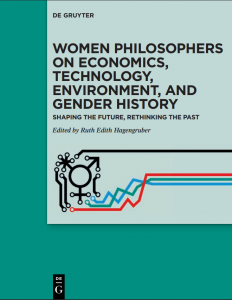 Hagengruber, R. (2023). Women Philosophers on Economics, Technology, Environment, and Gender History: Shaping the Future, Rethinking the Past. De Gruyter.
ISBN: 9783111050942
In times of current crisis, the voices of women are needed more than ever. The accumulation of war and environmental catastrophes teaches us that exploitation of people and nature through violent appropriation and enrichment for the sake of short-term self-interest exacts its price.
This book presents contributions on the currently most relevant and most urgent issues: reshaping the economy, environmental problems, technology and the re-reading of history from the non-western and western tradition. With an outlook into the problems of class, race and gender in its intersectional framing, the collection offers a unique overview of current research in these fields and contributes to the renewal and contemporary presentation of feminist thought from partly concrete perspectives with regard to factual issues.
-
(2025) Women and Their Body
Screenshot
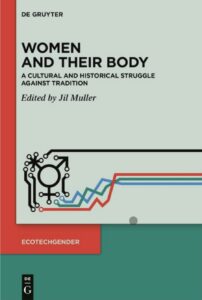
Muller, J. (2025). Women and Their Body: A Cultural and Historical Struggle Against Tradition. De Gruyter.
ISBN: 9783111396125
Women’s rights over their own bodies is one of the most pressing issues, esp. as women still seem to have fewer rights over their bodies than men. International authors from philosophy, literature, art, architecture, and gender studies address the topic from a variety of perspectives, reaching beyond classical feminism, and beyond the labels of “motherhood” and “sex.” The contributions are grouped into five sections – Body Experiences, History, Technology and Arts, Feminism and Phenomenology, and Beauty. Papers address a multitude of areas, ranging from beauty practices and Ukrainian women refugees in the context of the Russia-Ukraine war, feminist phenomenology and socio-structural critique, female specific neuropathology, the discourse of the Victorian women’s menstruation to “motherhood” in gender studies and feminist new materialisms. The book provides not only a comprehensive overview over the current state of research, but will also inspire further discussions. A separate bibliography listing relevant titles for readers new to the topics and for advanced researchers rounds out the volume.
-
(2026) Reclaiming Women’s Spaces
 Payongayong, M. T. T. (Ed.). (2026). Reclaiming Women’s Spaces: A Critical Acceptance of Filipino Women’s Contributions to Society. De Gruyter.
ISBN: 9783112237359
Inspired by Virgilio Enriquez’s insight that “uncritical rejection of anything foreign is as dangerous as uncritical acceptance of Western theories,” this volume reexamines how Filipino women’s contributions are understood within and beyond the Philippines. Bringing Filipino philosophy into dialogue with women’s history, it advances a decolonizing framework that moves beyond mere resistance toward critical acceptance and the reclamation of women’s spaces.
Through analyses spanning precolonial Babaylan priestesses, modern activists, scholars, and global migrants, the volume traces the significant roles Filipino women have played in education, labor, politics, and healthcare. It highlights how women’s leadership and agency have shaped national identity, challenged colonial legacies, and redefined the ethics of care from a cosmopolitan perspective.
Offering an important contribution to feminist, postcolonial, and migration studies, the volume proposes new ways of engaging with women’s knowledge and history without reproducing colonial hierarchies. Combining historical insight with philosophical reflection, it invites readers to reconsider how processes of decolonization transform not only our understanding of Filipino women, but also broader global narratives of gender, power, and care.
-
(2027) Women Philosophers and Scientists Against War and Ecocide
 Karpenko, K. (Ed.). (2027). Women Philosophers and Scientists Against War and Ecocide: The Ukrainian Context. De Gruyter.
ISBN: 9783112237144
This volume examines the social, cultural, ecological, and philosophical consequences of the Russian invasion of Ukraine through the perspectives of women philosophers, scientists, and scholars. Drawing on both lived experience and critical analysis, it addresses the interconnected challenges of war, gender, and environmental destruction in contemporary Ukraine.
The contributions explore a wide range of topics, including the gendered dimensions of war, ecocide and environmental devastation, women’s resistance and agency during wartime, sexual and gender-based violence, urban destruction and reconstruction, information warfare and propaganda, as well as the environmental and health impacts of armed conflict. Particular attention is given to the destruction caused by the Kakhovka Dam disaster and to Ukrainian responses to ecological and humanitarian crises.
Bringing together perspectives from philosophy, environmental studies, cultural studies, literary criticism, psychoanalysis, and social theory, the volume advances research on the interrelationships between war, gender, and ecology. It offers an important contribution to contemporary debates on conflict, environmental justice, and the role of women’s intellectual and political engagement in times of crisis.
Bibliothek der Philosophinnen
The Bibliothek der Philosophinnen is dedicated to making foundational works by women philosophers accessible to a contemporary German-speaking audience. The series publishes scholarly editions, translations, and critical commentaries of texts that have shaped the history of philosophy, science, and intellectual culture from antiquity to the modern period.
Many of these works have been overlooked despite their considerable influence on philosophical and scientific debates. By providing reliable editions, extensive introductions, annotations, and contextual studies, the series seeks to recover and reassess the contributions of women thinkers and to integrate them into the broader philosophical canon.
-
(2026) Émilie Du Châtelet: Naturlehre
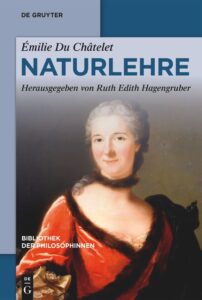 Du Châtelet, É. & Hagengruber, R. (2026). Naturlehre. De Gruyter. https://doi.org/10.1515/9783111714370
Die 1743 in Deutschland erschienene Übersetzung der Naturlehre wurde zu einem der wichtigsten philosophischen Bücher der deutschen Aufklärung. Wolff, Kant und Euler setzten sich intensiv mit den neuen Ideen der Philosophin Émilie Du Châtelet auseinander. Ihre Hypothesentheorie beeinflusste die Wissenschaftstheorie bis ins 20. Jahrhundert.
- Umfassende Einleitung zu Autorin, Werk und Wirkung
- Eine der erfolgreichsten Autor*innen des 18. Jahrhunderts
- Buch war sehr einflussreich für die deutsche Aufklärung
- Immer noch relevant für die Wissenschaftstheorie
You cannot copy content of this page