



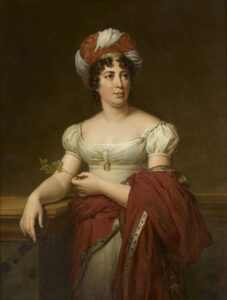
 Anne Louise Germaine de Stael-Holstein (aka Germaine de Stael)
*April 22, 1766 (Paris, France)
†July 14, 1817 (Paris, France)
Anne Louise Germaine de Staël-Holstein (1766-1817), née Necker, known as “Madame de Staël,” was an—at her time—enormously famous and widely influential intellectual figure in European letters and politics, from the French Revolution through the Napoleonic era into the Restoration period. She was the precocious and prodigiously talented daughter of the ultra-wealthy Geneva banker, international financier, economic and political theorist and finance minister to Louis XVI, Jacques Necker, and his wife Suzanne, a renowned Paris salonnière. Through her own salon and her numerous occasional and topical writings, Madame de Staël became a leading figure in contemporary debates, between the late Enlightenment and early Romanticism, about the role of the passions and the status of freedom in contemporary society.
Madame de Staël’s literary reputation rests on poetry, plays, novels (Delphine, 1802; Corinne, or Italy, 1807) and literary criticism. Her philosophical significance is based on highly original work in the sociology of literature (On Literature Considered in Its Relations With the Social Institutions, 1800) and comparative cultural anthropology (On Germany, 1813). In politics, she was an early supporter of the French Revolution, a vociferous opponent of Napoleon and a cofounder of modern liberalism.
Among her many and varied publications, On Literature stands out, due to its innovative combination of socio-political morphology in the tradition of Montesquieu’s Spirit of the Laws (1748) and French Enlightenment thought about the perfectibility of humanity’s achievements in all areas of culture, including the fine arts and government. A new edition of On Literature, undertaken by Günter Zöller, based on the only extant German translation from 1801, is in preparation for De Gruyter’s book series, Bibliothek der Philosophinnen.
The commemorative medallion of Madame de Staël, featured below, was designed and sculpted by the French artist, Hélène Guastalla (1903–1983), and struck in bronze by the Monnaie de Paris in the years 1967 through 1975. The obverse of the medallion shows Madame de Staël’s head in profile, seen from the left and with her hair stylized à la grecque, together with Madame de Staël’s name and life data. The reverse of the medallion features a quotation from Madame de Staël’s On Germany that can be found in the work’s Part 2, Chapter 28 (“On Novels”) and translates as follows: “In our modern times, the European spirit is needed.” The reverse also lists the French title of On Germany and its year of publication, incorrectly given as 1809.
~ Guenter Zoeller
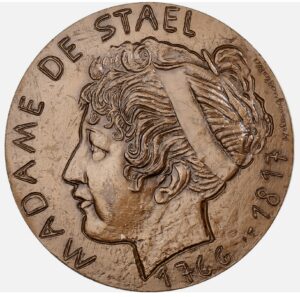
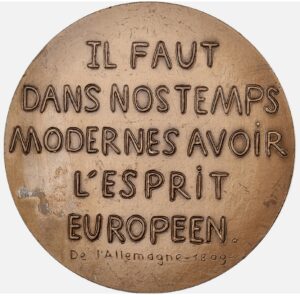
NumisCorner59. (o. D.). France, medal, Madame de Stael, 1967, MDP, bronze, Hélène Guastalla [Fotografie]. eBay.
https://www.ebay.co.uk/itm/326261557187
-
Primary Sources
De Stael-Holstein, A. L. (1785). Journal de Jeunesse.
De Stael-Holstein, A. L. (1786 (published anonymously in 1790)). Sophie ou les sentiments secrets.
De Stael-Holstein, A. L. (1787). Jane Gray.
De Stael-Holstein, A. L. (1788). Lettres sur le caractère et les écrits de J.-J. Rousseau.
De Stael-Holstein, A. L. (n.d.). Éloge de M. de Guibert.
De Stael-Holstein, A. L. (n.d.). À quels signes peut-on reconnaître quelle est l’opinion de la majorité de la nation?
De Stael-Holstein, A. L. (1793). Réflexions sur le procès de la Reine.
De Stael-Holstein, A. L. (1794). Zulma: fragment d’un ouvrage.
De Stael-Holstein, A. L. (1795). Réflexions sur la paix adressées à M. Pitt et aux Français.
De Stael-Holstein, A. L. (n.d.). Réflexions sur la paix intérieure.
De Stael-Holstein, A. L. (1795). Recueil de morceaux détachés (comprenant: Épître au malheur ou Adèle et Édouard, Essai sur les fictions et trois nouvelles: Mirza out lettre d’un voyageur, Adélaide et Théodore et Histoire de Pauline.
De Stael-Holstein, A. L. (n.d.). Essai sur les fictions. Translated by Goethe into German.
De Stael-Holstein, A. L. (1796). De l’influence des passions sur le bonheur des individus et des nations.
De Stael-Holstein, A. L. (n.d.). Des circonstances actuelles qui peuvent terminer la Révolution et des principes qui doivent fonder la République en France.
De Stael-Holstein, A. L. (1799). De la littérature dans ses rapports avec les institutions sociales.
De Stael-Holstein, A. L. (1802). Delphine.
De Stael-Holstein, A. L. (1804). Vie privée de Mr. Necker.
De Stael-Holstein, A. L. (n.d.). Épîtres sur Naples.
De Stael-Holstein, A. L. (1807). Corrinne, ou l’Italie.
De Stael-Holstein, A. L. (n.d.). Agar dans le désert.
De Stael-Holstein, A. L. (n.d.). Geneviève de Brabant.
De Stael-Holstein, A. L. (n.d.) La Sunamite.
De Stael-Holstein, A. L. (n.d.) Le capitaine Kernadec ou sept années en un jour (comédie en deux actes et en prose.
De Stael-Holstein, A. L. (n.d.). La signora Fantastici.
De Stael-Holstein, A. L. (n.d.) Le mannequin.
De Stael-Holstein, A. L. (n.d.). Sapho.
De Stael-Holstein, A. L. (1813). De l’Allemange.
De Stael-Holstein, A. L. (1813). Réflexions sur le suicide.
De Stael-Holstein, A. L. (1813). Morgan et trois nouvelles.
De Stael-Holstein, A. L. (n.d.). De ‘esprit des traductions.
De Stael-Holstein, A. L. (1818). Considérations sur les principaux événments de la révolution française, depuis son origine jusques et compris le 8 juillet 1815.
De Stael-Holstein, A. L. (1818). Dix Années d’Exil.
De Stael-Holstein, A. L. (1821). Essais dramatiques.
De Stael-Holstein, A. L. (1820-21). Oeuvres complètes 17t.
De Stael-Holstein, A. L. (1836). Oeuvres complètes de Madame la Baronne de Stael-Holstein.
-
Secondary Sources
Nassar, D., Gjesdal, K. & Ezekiel, A. C. (2021). “Germaine de Staël (1766-1817)”. In: Women philosophers in the long nineteenth century: the German tradition. (S. 23-61). Oxford University Press, New York.
- ECC
- Online Sources
- Projects
You cannot copy content of this page